Saturday, August 27, 2022

River North Notes: Chicken

     Today's Saturday essay by North Shore Bureau Chief Caren Jeskey needs no introduction. Except I suppose this: enjoy.

     By Caren Jeskey

     Thank goodness for NPR. Tasty tidbits of information are almost constantly funneled into my voraciously hungry ears, nearly commercial free, thanks to public radio. KUTX out of Austin keeps me attuned to some of the greatest music of all time, old and new. That’s where I found the stunning voices of Alex Maas of the Black Angels, Heartless Bastards' Erika Wennerstrom, and the croons of a distant relative of Davey, Charly Crockett

     I relied on Click and Clack the Tappet Brothers to keep me company on many a cold Saturday morning when Car Talk was airing, even though I did not own a car. The Magliozzi brothers’ schtick was hilarious, brilliant, and comforting with their simple joie de vivre. When I got a car, I had countless driveway moments— when I could not turn the radio off since 1A or The Moth wasn’t over over yet. (That was before I had Bluetooth earpods; now I can take the shows with me wherever I go).   
     It must have been a soundbite on WBEZ or KUT where I learned that chickens were not always used as human food. Lore has it that they were revered, kept as indoor pals, and considered to have supernatural powers. Fossilized chicken bones reveal that some of our feathered friends received ancient medical interventions that set broken bones, and humans were buried with their two winged friends. Apparently the birds were a conduit to a desirable afterlife. It wasn’t until A.D. 43 when Romans made it to England that the growing British population realized that these prolific pets were rotund and tasty, and the masses needed food. Enter chicken and dumplings.
     I was an apple pie American kid and chicken was a dinner time staple growing up. Shaken and baked, roasted, shredded for taco night, or fried and served with incidental greens and buttered honey biscuits.
     As kids we couldn’t get enough visits to the Lincoln Park Zoo to watch their smooth white eggs crack open, gooey dinosaur bodies turning into fluffy yellow fur balls before our eyes.
     That’s why, in the early '70’s, when my sister and I were offered the choice of a baby chick or a baby duck to take home from Easter Brunch at the Hotel Continental, we chose the tiny relatives of Kentucky Fried.
     My Grandma Olive, who’d moved to Chicago at the age of 14 on her own, all the way from Wilmington Delaware, was a head cashier at this glorious hotel. We were her guests. My sister and I wore frilly dresses, white tights and black patent leather Mary Janes, and we each had a rabbit fur muff around our necks to nestle our chilly hands into. We felt very fancy. When we were sent home with baskets of plastic grass, chocolate eggs and live birds we were over the moon.
     Ah, simpler times. When my folks were young enough to do foolhardy, spontaneous things.
     This week I’ve been staying on Randolph near the lake, taking care of a friend’s little dog. On Tuesday I met colleagues at The Hampton Social for a light dinner. When we left, I walked one of them up the stairs to Michigan Avenue where we saw her bus, the 147, just closing its doors. I cheered her on as she ran towards it. The driver stopped and re-opened the door, and she hopped on. She gave me the thumbs up and off they went.
     Just then I noticed many police sirens just north of there. I briefly wondered what was happening, then thought better of it. It had been a long day full of a broken down car and a mean bus driver on the Western bus. Instead of helping me figure out my Ventra app, he said that I must be stupid to have an app that I don’t know how to use.
     I’d had enough stress, so I turned away from the sirens towards the stunning architecture. A far cry from my little rental home in Kenilworth Gardens. Eye candy galore.
     I passed the Hotel Intercontinental and flashed back to the days when my Grandma Olive was still with us. Being in the restaurant business, she knew everyone. We were treated like royalty on our birthdays in high-backed throne-like chairs at Kon Tiki Ports, housed in this building. A stately statue of Nathan Hale in front of the Tribune Tower commanded a second look; I wondered who he was, and if his statue would last.
     I crossed Michigan and came across a couple being photographed for their wedding, beaming without a care in the world. I looked over the railing towards the river and noticed the shape and structure of Trump’s building for the first time. In the past, I’d think “Rump” and turn away in disgust. This time I saw that the building itself is not hard on the eyes, albeit way too big. Looking east towards Jeanne Gang’s masterpiece my good sense returned. Nothing The Donald does is OK. Even though Trump Tower and Gang’s Vista Tower have a similar blue mirrored look, Trump’s building suddenly looked like a strip mall compared to Gang’s exquisite wavy towers.
     Heading south, the sound of some very good blues emated through speakers out of a one man band. I noticed the Nutella Cafe for the first time and wondered what that was all about. Then I noticed the long line and stopped wondering; maybe another time.
     I’ve been hearing deafening whirs and whizzes and backfires from cars late at night from my perch in a highrise on Randolph; likely versions of the street takeovers that Neil recently made mention of on his Facebook page. When reading the Sun Times story about these late night sideshows, I noticed the headline of another article where I learned a possible reason for the sirens of Tuesday evening. They were perhaps heading towards the horrible tragedy of a 36 year old man who had been stabbed to death on Ohio near Dearborn at the same time I was meandering around wondering if I should get some chocolate hazelnut dessert. As much as Chicago feels like home, sometimes I feel like the scared visitors from out of town who I used to think were being just plain silly.

Friday, August 26, 2022

The limitations of statues

     So I was thinking about Gotthold Ephraim Lessing this morning and wondered what you make of him.
     Are you an admirer? A critic?
     What? You’ve never heard of Gotthold Ephraim Lessing? No! Perhaps his 1748 play will ring a bell: Der Junge Gelehrten, or “The Young Scholar.”
     Still no? How can that be?! There’s a statue of him big as life in Washington Park. For almost a century.
     Point made? Good. Statues are vastly overrated as tributes, or mnemonic devices, or anything other than hunks of bronze that sit neglected in parks providing roosts for pigeons.
     Well, I suppose they’re also something for people to bicker about. Endlessly. With Columbus Day closing in, and Lori Lightfoot’s kick-the-can-down-the-road Chicago Monuments Project bouncing back into view after two years of tumbling forward — in brief: keep the three Columbus statues mothballed and ditch 10 more that reek of white supremacy — I would be in danger of having my pundit card revoked if I didn’t flip my palm toward the air and glibly opine.
     The 73-page report is nuanced. Summarizing it makes it sound more extreme than it actually is. When I first read news stories about about its findings, my takeaway was the commission managed the neat trick of finally making me sympathetic to keeping Columbus by suggesting that the bas-reliefs on the DuSable Bridge should go. Those are gorgeous and if they are a little History as Told By John Wayne, well, nobody said America is a tidy, fair place. The cowboys won, right?
     But the report doesn’t suggest the offending panels simply be jackhammered away for “their allegorical representation of the triumph of Western civilization.” There are landmark considerations and maybe a “powerful, non-physical and possibly periodic, deactivation or disruption of these works” would suffice, which I imagine involves giving $10,000 to a School of the Art Institute student to devise a light show strobing blood red flashes across the bas-reliefs while looped shrieks startle passing tourists.
     Why not? Times change and we change with them. We’ve been battering each other for so long over this literal deadweight from the past, I’m wondering if it isn’t time to try to get a little smarter about it.

To continue reading, click here.

Thursday, August 25, 2022

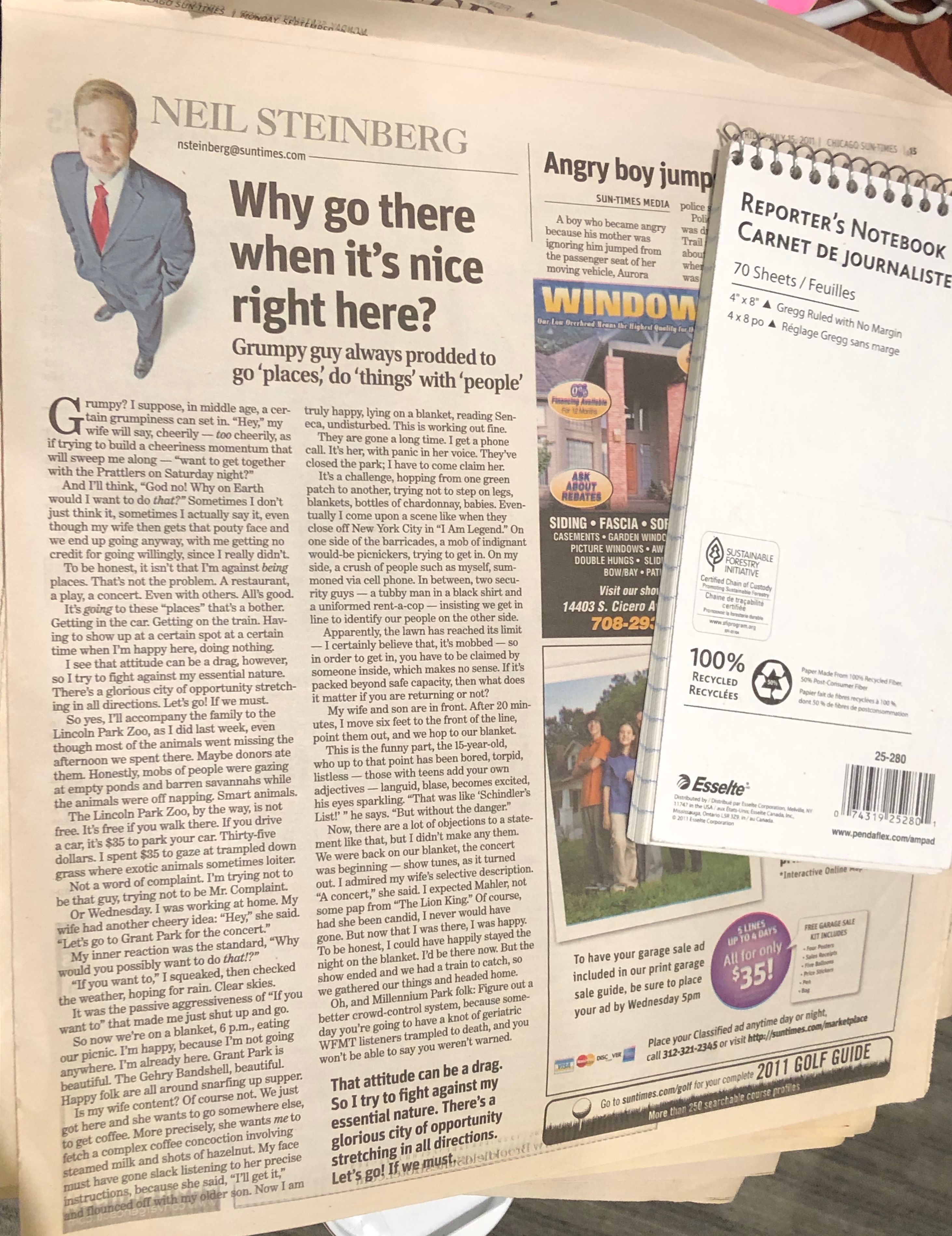
Flashback 2011: Why go there when it's nice right here?

 
   I started packing up my office at the paper Wednesday, dragging boxes home to put in the basement next to the unopened boxes from the 2004 and 2017 moves. It's melancholy, challenging, work—nobody cares at all about this stuff, other than me, and sometimes not even me. This move also has an air to finality to it. I've had a newspaper office downtown for 22 years, and while I'll still have the right to sign up for an afternoon at a workstation at The Old Post Office or at Navy Pier, it won't be the same. 
      What to save?  Most writing is online, of course. But not everything about a column is written. For instance, the distinctive, fly-on-the-ceiling column bug at right, in color yet, caught my attention.
     Look at that guy, hands in pockets. Amused smirk. Bright red tie. Jesus, I've worn a tie once in the past three years, and that was to the wake of a friend. I used to wear a suit every day to the office, just in case I unexpectedly found myself in the mayor's office or at a ball at the Palmer House.
     I read the column. Usually, I'm struck by the sameness of the voice in the columns. I sound  the same now as when I was 17. But this column has more ... brio than I seem to manage lately. The work of a man who hasn't been staring into the hellmouth of Donald Trump and his carnival of demonic dupes for seven years. Or isn't 62.
     Reading it I began to wonder if I'm not a little ground down. Ironically, I went to the Lincoln Park Zoo this summer and had exactly the same reaction as 11 years ago: "Where are the animals?" 
     One aside in particular, "Maybe donors ate them," made me wonder if I've lost a step. I'm not sure I'd come up with that now. I hope so. And those who stroll out of Millennium Park during concerts are still shut out of the park by the Barney Fifes. They should issue wristbands or something. My parting entreaty related to that fell on deaf ears. 

     Grumpy? I suppose, in middle age, a certain grumpiness can set in. “Hey,” my wife will say, cheerily — too cheerily, as if trying to build a cheeriness momentum that will sweep me along — “want to get together with the Prattlers on Saturday night?”
     And I’ll think, “God no! Why on Earth would I want to do that?” Sometimes I don’t just think it, sometimes I actually say it, even though my wife then gets that pouty face and we end up going anyway, with me getting no credit for going willingly, since I really didn’t.
     To be honest, it isn’t that I’m against being places. That’s not the problem. A restaurant, a play, a concert. Even with others. All’s good.
     It’s going to these “places” that’s a bother. Getting in the car. Getting on the train. Having to show up at a certain spot at a certain time when I’m happy here, doing nothing.
     I see that attitude can be a drag, however, so I try to fight against my essential nature. There’s a glorious city of opportunity stretching in all directions. Let’s go! If we must.
     So yes, I’ll accompany the family to the Lincoln Park Zoo, as I did last week, even though most of the animals went missing the afternoon we spent there. Maybe donors ate them. Honestly, mobs of people were gazing at empty ponds and barren savannahs while the animals were off napping. Smart animals.
     The Lincoln Park Zoo, by the way, is not free. It’s free if you walk there. If you drive a car, it’s $35 to park your car. Thirty-five dollars. I spent $35 to gaze at trampled down grass where exotic animals sometimes loiter.
     Not a word of complaint. I’m trying not to be that guy, trying not to be Mr. Complaint.
     Or Wednesday. I was working at home. My wife had another cheery idea: “Hey,” she said. “Let’s go to Grant Park for the concert.”
     My inner reaction was the standard, “Why would you possibly want to do that!?”
     “If you want to,” I squeaked, then checked the weather, hoping for rain. Clear skies.
     It was the passive aggressiveness of “If you want to” that made me just shut up and go.
     So now we’re on a blanket, 6 p.m., eating our picnic. I’m happy, because I’m not going anywhere. I’m already here. Grant Park is beautiful. The Gehry Bandshell, beautiful. Happy folk are all around snarfing up supper.
     Is my wife content? Of course not. We just got here and she wants to go somewhere else, to get coffee. More precisely, she wants me to fetch a complex coffee concoction involving steamed milk and shots of hazelnut. My face must have gone slack listening to her precise instructions, because she said, “I’ll get it,” and flounced off with my older son. Now I am truly happy, lying on a blanket, reading Seneca, undisturbed. This is working out fine.
     They are gone a long time. I get a phone call. It’s her, with panic in her voice. They’ve closed the park; I have to come claim her.
     It’s a challenge, hopping from one green patch to another, trying not to step on legs, blankets, bottles of chardonnay, babies. Eventually I come upon a scene like when they close off New York City in “I Am Legend.” On one side of the barricades, a mob of indignant would-be picnickers, trying to get in. On my side, a crush of people such as myself, summoned via cell phone. In between, two security guys — a tubby man in a black shirt and a uniformed rent-a-cop — insisting we get in line to identify our people on the other side.
     Apparently, the lawn has reached its limit — I certainly believe that, it’s mobbed — so in order to get in, you have to be claimed by someone inside, which makes no sense. If it’s packed beyond safe capacity, then what does it matter if you are returning or not?
     My wife and son are in front. After 20 minutes, I move six feet to the front of the line, point them out, and we hop to our blanket.
     This is the funny part, the 15-year-old, who up to that point has been bored, torpid, listless — those with teens add your own adjectives — languid, blase, becomes excited, his eyes sparkling. “That was like ‘Schindler’s List!’ ” he says. “But without the danger.”
     Now, there are a lot of objections to a statement like that, but I didn’t make any them. We were back on our blanket, the concert was beginning — show tunes, as it turned out. I admired my wife’s selective description. “A concert,” she said. I expected Mahler, not some pap from “The Lion King.” Of course, had she been candid, I never would have gone. But now that I was there, I was happy. To be honest, I could have happily stayed the night on the blanket. I’d be there now. But the show ended and we had a train to catch, so we gathered our things and headed home.
     Oh, and Millennium Park folk: Figure out a better crowd-control system, because someday you’re going to have a knot of geriatric WFMT listeners trampled to death, and you won’t be able to say you weren’t warned.

Wednesday, August 24, 2022

TV stardom is just the beginning

 
Michael V. Epps

    
     Which is harder: acting in a television show or playing video games professionally?
     Michael V. Epps thinks about that one.
     “I want to say acting,” he replies. “Playing a game, you make your own schedule. Acting, you have to know your script, and you have to be ready to work a full day.”
     Epps stars in the multigenerational ensemble drama “The Chi”; its season finale is on Showtime Sunday, Sept. 4.
     Production doesn’t start up again until January. In the meantime, Epps is building a following on Twitch, the video livestreaming platform where viewers pay to watch top gamers do battle. That workday varies when it comes to hours spent on the consol
     “I try to get one, two, or three,” says Epps, 16, who prefers Call of Duty and NBA 2K. “More than that. An hour goes by real quick.”
     His other project is Crown Me Clothing, a fashion line of black T-shirts and colorful hoodies.
     “We want to uplift people,” he said. “The motto is ‘Claim your royalty.’ We want people to strive for greatness.”
     If you’re wondering why you’re reading about a teenage actor, gamer and budding fashion tycoon — not my usual subject matter — that’s easy: His publicist asked, and I thought, “Why not?”
     I haven’t watched enough of “The Chi” to categorize it confidently: I’d call it a fast-paced Black soap opera set on the South Side. Epps plays Jake Taylor, whose gangbanger older brother is killed in a drive-by shooting.

To continue reading, click here.

Tuesday, August 23, 2022

Cri de coeur


     School begins this week, in Chicago and surrounding suburbs. Kids battered by years of COVID lockdown and terrifying periodic slaughters — my colleagues Sophie Sherry and Ashlee Rezin had a heart-tugging front page story on Highland Park parents and kids facing the traditional back-to-school excitement with fear — packed off to classrooms while their parents argue over what they should be taught.
     My neighbor, who has an energetic brood of kids and a tendency to express her frustrations on chalk in the sidewalk in front of her bright blue house, left this message a few days ago: "Go back to school NOW. I'm so tired."
     I saw it and thought, "Now there's a cri de coeur."
     French for "cry of the heart," I'm not sure why the sentiment works better in French, but it does. "Passionate outcry' just isn't the same. My "World Dictionary of Foreign Expressions" calls it "A profound utterance of anguish."
     To me it implies a certain flayed candor. No hedging, no soft-pedalling, the soul's very vibration. Most mothers feel this sort of thing; few announce it on the sidewalk.
     There is a poem of that name, "Cri de Coeur" by C. Dale Young. Nothing to write home about, with a single line worth chewing: "Sleeping god in an age of plagues." Take a look and argue if you like. "Age of Plagues" is available for a title for anyone writing about our current day.
     As it happens, I passed my chalk-wielding neighbor the next night, setting up a lawn display wishing her oldest, a 19-year-old daughter, a happy birthday. We talked a bit, and I almost said, "If you want heartache, wait until they leave and the echoes die down and the horizon is a flat line without hope of a smokestack."
     But that seemed an even more dire message and, besides, she'll find out soon enough.


Monday, August 22, 2022

Talk about getting rid of the gray


     When I try to explain to Americans who Lisa LaFlamme is, I usually say she’s the Katie Couric of Canada: a trusted television anchor on screens across the country.
     Such shorthand is necessary because you could be the Queen of Canada and still entirely unknown to 99.99% of people in the United States.
     Before last week, the subject of LaFlamme arose in my circle because she is also the significant other of this paper’s former editor and my current friend, Michael Cooke, a perennial topic of conversation in the way that only a certain kind of brash Brit can be.
     LaFlamme posted a heartfelt video on Twitter last Monday, announcing that the anchor chair had been yanked out from under her by CTV News’ parent company, Bell Media.
     “I was blindsided,” she said. “And am still shocked and saddened by Bell Media’s decision.”
     Viewers naturally suspect she was let go because she let her hair go gray during the COVID-19 pandemic.
     Couric, despite being a serious journalist, was often dismissed as merely perky. So LaFlamme, though doggedly covering the biggest international news stories, was also a woman atop a male-dominated industry, so not always treated seriously. Her decision to stop dying her hair made national headlines in Canada.
     Headlines like “The silver lining to letting our grey hairs flourish during the pandemic,” — parroting the Brits, they call gray “grey” up there — over an opinion piece in the Globe and Mail reaching a conclusion that obviously eluded CTV top brass: “Ms. LaFlamme could have easily sprayed her roots with a shot of Magic Root Cover Up ... but instead decided to let her grey flag fly, and in doing so she somehow earned even more of my trust and respect. So is grey the new honesty?”
     Not at CTV. Speaking of honesty, I was initially inclined not to write about LaFlamme — going to bat for a pal’s partner is not exactly Journalism 101. But the Washington Post thought this important enough to weigh in Friday:
     “The abrupt dismissal of one of the country’s most prominent television journalists — she has led Canada’s most watched nightly newscast since 2011, and this year won the Canadian Screen Award for best national news anchor — has drawn both a backlash and a national conversation about sexism and age discrimination in the media.”

To continue reading, click here.

Sunday, August 21, 2022

Flashback 1990: `Working poor'? It's a state of mind


     Reacting to anything Darren Bailey says is probably pointless. He's a downstate dope spraying his ignorance around in the mistaken belief that doing so might get him elected governor. Barring tragedy, he won't even be a political footnote.
     And yet he flails. One tactic that goes over big in his world is slurring Chicago, since insulting Black people directly is no longer fashionable, even in his milieu. So he uses code; a combination of racism AND cowardice. Though those two qualities are really just two sides of the same coin.
     When Bailey called Chicago "a hellhole" twice at the Illinois State Fair, my former colleague Monica Eng, now at Axios, asked him if people living in Chicago also believe they live in a hellhole, and he replied "Actually, I believe they do. Because it's unsafe."
     He believes. He doesn't know because he hasn't asked them, and hasn't asked them because he's barely set foot in Chicago. He believes that to be the case because he is a practitioner of the classic Fox News mind-reading trick, whereby bigots try to give a sheen to their loathsome thoughts by projecting them upon others. I would bet that for every Chicagoan who thinks they live in a hellhole, there are 50 who think Bailey is an idiot, or would, if they'd ever heard of him.
     Common sense — the common sense that Bailey so obviously lacks — tells us that most people anywhere, no matter their condition, do not consider themselves to be living in misery, never mind a hellhole. They have pride in their homes, modest though they might be. Troubled though they might be.
     This reminded me of a story over 30 years ago when one of the geniuses at City Council declared alderfolks like herself to be the "working poor." Editor Alan Henry's eyes lit up with that sort of glee that has become rare in newspapers nowadays. He gave me an assignment that was more like whittling a splintery pointed stick to shove up the politician's backside, a task that I understood immediately and executed with pleasure, hurrying to her ward, finding the most abject residents I could, people literally grovelling in the mire, collecting aluminum cans, and asking them: "Do you consider yourself poor?" 


"We are the working poor."
          — Marlene Carter, $40,000-a-year alderman of the 15th Ward, arguing last week that aldermanic salaries should be raised to $65,000
.

     On bleak, garbage-strewn streets of Marlene Carter's 15th Ward, the real working poor are too proud to call themselves that.
     Marvin McKinley, pushing a shopping cart filled with a broken bike frame, a spool of garden hose, crushed cans and assorted castoffs, doesn't think of himself as poor.
     "I'm middle class. Middle class," said McKinley, 34, savoring the words. McKinley estimates he earns $8,000 a year selling scrap. "Aluminum. Copper. Anything you can make a dollar off."
     Willie Lee Lewis, a father of 12 who earns $7 an hour raking up sludge and trash in an empty drive-in movie parking lot, doesn't see himself as poor, either.
     Nor does he think Ald. Carter deserves a 62 percent raise.
     "I never see her around here yet," he said, gazing into the distance. "You want a raise, you should be around here. I've been here 10 years, I haven't seen her yet."
     "The only time I see her is on television," said Willie Luckett, 74, standing in the doorway of his daughter's store, waiting patiently for 63rd Street to offer up a customer.
     Far from being "poor," — the U.S. Commerce Department poverty line for a family of four was $11,611 in 1987 — Carter has an income approximately double that of the average Chicago family.
     According to 1979 census statistics, the median income for a typical Chicago household was $18,776. The newest census data, observers agree, will show a slight increase to approximately $20,000.
     In 1979, aldermanic salaries went from $17,500 to $22,500.
     Since then, they have almost doubled, while Chicago's median family income increased by less than 10 percent.
     The Public Works Department reports median family income in some wards is as low as $7,325. The median in the South Side 15th Ward is $18,391 — less than a third of the proposed $65,000 aldermanic salary.
     Even the richest families — those in the 13th, 18th, 19th, 23rd, 41st and 43rd wards — earned a median income of between $25,000 and $30,000, a full $10,000 less than Carter earns as alderman.
     Or, in other words, the $25,000 raise the aldermen are requesting is equal to the total average pay of families in the wealthiest wards.
     As a rule, those closer to Carter's salary level tend to be more understanding of some aldermen's desire for more money.
     John Pawlikowski, owner of Fat Johnnie's hot dog stand, 7242 S. Western, sympathizes with Carter.
     "Who can live on $40,000 a year?" asked Pawlikowski, who supports a raise for Carter. "She does a good job. This place was loaded with hookers."
     "I see no need why there couldn't be some kind of increase in income," said Phillip Whorton, 61, a contractor overseeing tuckpointing on the New Zion Grove Mission Baptist Church, 64th and Wolcott. "Though 62 percent is a little high."
     Other residents are adamantly opposed to the size of the proposed increase.
     "I'm against that," said Bob Anderson, selling fruit off the back of a truck at 63rd and Yale. "That's a big jump. Everybody's entitled to a raise, but I don't think they are entitled to that much."
     "They don't need no raise, they need to give somebody a job," said McKinley, angrily, searching the side of the road for scrap. "A man needs an eight-hour-a-day job."
     Chicago Association of Commerce and Industry President Samuel Mitchell reflected the view of most business and civic group leaders when he said aldermen must first agree to give up any outside incomes and jobs before they can "seriously call for a pay increase."
     Officials of the Chicago Civic Federation said aldermen should also agree to curb City Council spending before considering any kind of wage increase.
     The opposition expressed by residents of the 15th Ward is mirrored across the city. A WBBM-Channel 2 News telephone poll found a resounding 96.6 percent of Chicagoans opposed a pay increase.
     One of them is Roger Eugene, 41, who stooped to pick aluminum cans out of the mud covering a vacant lot in the 15th Ward.
     "I sell the aluminum at 59th and Bell," said Eugene, who gets about 50 cents a pound. "On a good day, I get 13, 14 pounds — never less than eight."
     Eugene, a disabled Vietnam vet whose rent is $150 a month, begs to differ with Ald. Carter on her vision of herself.
     "Oh no," he said. "That ain't poor."