Tuesday, July 14, 2015

Chicago Fire Week #2: The floating firehouse

Photo by Chad Kainz, Chicago


     It took a bit of sweet-talking, but eight years ago I got myself aboard the city's only fireboat. She was replaced in 2011 with a newer fireboat, the Christopher Wheatley, but not before a final good deed: rescuing a coyote stranded on a tiny ice flow off Fullerton Avenue.


   Among the 97 firehouses in Chicago, Engine 58 is unique in several ways. Its living quarters are the smallest. Its rig is the oldest, with the last hand-rung brass bell in the department -- or so they claim. And it has, without doubt, the wettest basement -- the channel of water between the Jardine Water Treatment Plant and Navy Pier.
     Engine 58 is a fireboat, the Victor L. Schlaeger, the last fireboat operated by the Chicago Fire Department, and if you're not excited to carefully hop from the pier onto her 92-foot-long deck on a perfect September morning, then friend, check your pulse, because you're not alive.
     "It's a floating firehouse," says Relief Lt. Art Jansky, who suggests a look below decks with a very unnautical "You wanna see downstairs?"
     It has a crew quarters, with six beds -- five firefighters man it 24 hours a day, just like any other firehouse. It has a TV, an exercise bike, a kitchen, two toilets, a shower.
     "All the comforts of home," Jansky says.

SIX DEAN HILL FIRE PUMPS
     Well, a home that moves—another unique aspect. Engine 58 is the only company that takes its firehouse out on runs. Also a home with four water cannons— "deck guns" they're called—two fore, two aft. The Schlaeger's deck guns have any truck in the department beat— the best a hose from a rolling pumper can do is 400 gallons a minute, while each of the Schlaeger's guns spews forth about 1,200 jetting, hissing, foaming gallons per minute. They have to take care, fighting fires on smaller boats, that the force of the water doesn't sink them, or spin the Schlaeger around.
     "These things will move the boat," said Engineer Dwain Williams.
     They took the fireboat out by the breakwater, and invited me to operate the deck guns, turning the big chrome wheels that raise and lower the gun and sweep the horizon. They didn't have to ask twice—maybe you need to be a boy to truly appreciate the thrill of cranking up that 4-foot-long barrel and watching the powerful stream gush forward. All that was missing was a fresh snowbank to trace my name in.
GROSS WEIGHT: 209 TONS

     The Schlaeger was built in Sturgeon Bay, Wis., in 1949. She is by no means a beautiful vessel, riding low in the water, her smokestacks cut short, the better to go under low bridges. She can float in seven feet of water, and her eight engines will push her to 14 knots. With bow plates made of steel nearly two inches thick, she'll break through eight inches of ice. In the winter, bubblers keep the water ice-free 20 feet around her berth, in case the fireboat needs a running start.
     "It's a little old, a little tattered, but you know what -- this puppy is sound," Williams said. "It'll do the job."
     It's hard to find a job that the fireboat hasn't done over the years. It has fought fires, of course, on water and on land, including a massive 5-11 warehouse blaze on the Southwest Side 10 years ago. But it is also a platform for divers, and has rescued people from sinking boats and downed helicopters (including a Fire Department helicopter that crashed attempting a rescue). During heat waves it pours water on downtown bridges to keep them from swelling closed. In the parched summer of 2005 it watered riverside trees. On the Fourth of July, it parks next to the barge setting off the fireworks over the lake, just in case. And of course no festive waterside event is complete without the Schlaeger firing its cannons high into the air in watery salute. Talk about gushing.
     Nor is its range limited by the reach of its cannons—the Schlaeger has eight discharge outlets and a bellyful of hose, used to connect with land companies. The boat's six pumps can move 14,252 gallons per minute.
     "We become a fire hydrant and can supply 10 engines," Williams said.
     The first Chicago fireboat, the Geyser, was commissioned in 1886. At one time there were five fireboats protecting the grain elevators and factories along a Chicago River spanned by wooden bridges.
     The Schlaeger has been the only fireboat in Chicago for more than 10 years ever since its sister vessel, the Joseph Medill, was decommissioned and exiled to Wisconsin.
     A fireboat is one of those budget items that make cost-cutters' fingers itch—it doesn't make as many runs as a regular engine company, and has all the hole-in-the-water-you-fill-with-money drawbacks associated with any boat.
     But when you need a fireboat, you really need it, and I can't help but think that the increasing number of residents living along the riverfront must sleep a little better at night high above the city in their luxury condos knowing that there are five guys sleeping below decks on the Victor L. Schlaeger, ready to help at a moment's notice.
SO WHO IS HE?
     Nobody aboard Victor L. Schlaeger, the boat, had any idea who Victor L. Schlaeger, the man, might have been. I promised I would find out.
     Born in Chicago, a graduate of Bowen High School, Schlaeger became a powerful Cook County Democrat, known for his efficiency, who worked his way up through government -- to county treasurer and chief clerk of the Superior Court -- before being elected recorder of deeds, the position he held in 1949 when he collapsed and died during lunch at the Bismarck Hotel. The boat, commissioned a few months later, was named in his honor, perhaps because he served in the Navy in World War I.
                     —Origially published in the Sun-Times, Sept. 23, 2007

The Victor Schlaeger in 2021.


Monday, July 13, 2015

Who doesn't hate squirrels?

 
Photo courtesy of Janet Rausa Fuller

   On Tuesday, the Northbrook Village Board is considering whether to ban the practice of setting out food for wild animals. While that is the typical thumb-twiddling leaders here engage in rather than doing anything productive, I understand the concern. The idea that people would set food out for squirrels and skunks and such just baffles me. It's like planting weeds.
     On the other hand, unless they're going to ban bird feeders—and no politician could do that and hope to be elected, it would be like banning toddlers—the effort is futile, since squirrels so readily climb them and eat the poor hungry birds' lunch (though not in my backyard, since, after years of trying, I have finally baffled them, quite literally).
     Anyway, I would say table the vote and consider more important things. But the effort did bring to mind this column where I declared my feelings for squirrels. 

     Squirrels scare me.
     Squirrels have, on occasion, menaced and attacked me. I hate them. Which makes it doubly ironic that, in my new home in the deep forests of Northbrook, I am surrounded by squirrels. I can feel their small, hard, coal-black eyes upon me.
     Normally, I would be too embarrassed to mention this. You probably love squirrels. You probably collect little china squirrel figurines and keep them in a special cabinet. How nice.
    But I'm trying to make sense of the other day, which turned into my Big Squirrel Day.
    It began with my oldest boy, gazing out the bedroom window. Suddenly, he shouted, "Call the police! Call the police!" I ran to the window. "What?" I asked. "Squirrels!" the 4-year-old said. "On the garbage can!"
    Indeed, there were two big ones, boldly perched on the lid, planning their next crime.
    Not two hours later I was visiting my pal Judy at WGN. "I have something in my office for you," she said, during a commercial break. My mind reeled, pondering expensive presents. You know how they pay these radio people. Someone had given her a Harley-Davidson. She had no use for it . . .
    What she had was a press release from the Squirrel Lover's Club. This week is the first "Squirrel Awareness Week." Joy.
    Ever look closely at a squirrel? They twitch as if they're about to explode, or have some terrible disease. I glanced at the release, put out by a fanatic in Elmhurst, filled with cold-comfort trivia such as the number of teeth squirrels have (22), including "chisel-shaped incisors in the upper and lower jaws."
    Of course they do. A squirrel once tried to chew its way into our bedroom. I heard my wife shrieking and there was a tremendous gnawing and scratching at the plastic accordion section around the air conditioner. A peep through the window confirmed that it was a maddened squirrel, trying to get us. The next few moments were like something out of a horror movie. This was not an isolated episode. On vacation, my family was eating around a picnic table at White Pines State Park when a squirrel charged up and tried to strong-arm our food.
     The thing terrorized us, hissing and spitting. My poor boys were upset, and I had to manfully fend off a squirrel in front of them. I defended our meal, if I recall, with an unopened can of baked beans.
     After trying to read over the ballyhoo for Squirrel Awareness Week and despairing of the subject, I stood up to stretch and gather my thoughts.
     So many squirrel lovers and people who get all squishy at the mention of any animal. Not worth antagonizing them, I decided. And to what end? To score points against squirrels? It's not as if they're going to change their ways.
     I turned toward the City Desk, and looked at the TV monitors bolted to the ceiling. Squirrels, and lots of them. Various critters and poses, touting Squirrel Awareness Week.
     "Squirrels," I said. "I hate those - - - - - - - squirrels."
     One of the hard cases at the desk agreed. "Blanking squirrels," he said. So it isn't just me. There are at least two of us.
      Buoyed by this sign of solidarity, I returned to my desk, and read: "In some circles . . . squirrels spelled doom on a house."
     This dislodged the most disturbing squirrel memory of all. A few days after we bought the house, I was walking out front, along the hedge. Just as I turned the corner, into our yard, I saw a squirrel pulling itself toward the house with its front paws, back legs dragging uselessly behind it.
     I had never seen a paralyzed squirrel before, and couldn't imagine how it would happen -- a fall? A terrible illness; the things are silly with disease. It was a haunting sight.
     There is one consolation, however. Winter is coming. The miserable beasts sleep, right? They hibernate, don't they? Good Lord, I hope so.

   —Originally published in the Chicago Sun-Times, Oct. 5, 2000

    Coda: Years after this ran, I discovered that my next door neighbor was in the habit of shooting the squirrels in his yard with a BB gun. Which probably explains the paralyzed squirrel — one of his victims. The realization almost gave me a shiver of sympathy for the poor squirrels. As well as making me miss my neighbor.

Chicago Fire Week # 1: "I asked God to send the angels"


     I realized I haven't used any vacation in 2015, so took this week off at the paper. A break which will be undercut if I keep busy here. 
     But I didn't want to leave you folk with nothing. I was puzzling over what to do, on the elliptical at the Y, listening to Bonnie Tyler's 1980s chestnut, "Holding Out for a Hero." Heroes made me think of firefighters, and I realized I could run some columns about the Chicago Fire Department, which are by nature thrilling, and some of my favorite stories. 
     Plus they're so rare. Being actual heroes, fire fighters don't like to talk about their exploits. It strikes them as bragging. The column below would never have happened had the minister not forced the guys to talk. 
     There is also, I believe, paradoxically, a certain timidity at work too. Firefighters, like cops, work in close quarters, in an unfair, rigged hierarchy where personal initiative can be punished: you don't want to stick out. It's safer not to talk to a reporter, ever, about anything. 
     So five days of fire stories this week—I might jump in on an issue, but only if I feel inclined. Otherwise I'm reading in the hammock, gardening and, I imagine, doing various chores around the house.  I hope you like these, because if a reporter can't do something engaging about a fire, he's in the wrong business.
     The only downside is I don't have any good fire photographs. The one atop the blog is from Wikicommons, courtesy of Wesha. If you have a good one, send it to me, and if I use it as a header, I'll give you credit, and pay you 20 bucks.
     
     When a church burns, it's usually a goner.
     Old woodwork ignites like tinder. Cathedral ceilings hide spaces where fire spreads undetected. Plaster falls in heavy chunks, shattering oak pews. One beam goes and the whole ceiling pancakes down, walls collapsing outward.
     St. John United Church of Christ, a small, 90-year-old brick building on Moffat Street, its modest congregation bolstered by hundreds of recovering alcoholics, seemed doomed in the pre-dawn darkness last Jan. 20.
     When Engines 43 and 57 and Trucks 28 and 13 of the 6th Battalion arrived, fire had blown through the third-floor choir window, and flames were flapping out. Yellow-green smoke poured from the eaves.
     The vehicles were met by the pastor, the Rev. Charlotte Nold, standing before her burning church.
     "I live next door," she explained. "My phone rang, the doorbell rang desperately, and I heard the fire engines all at the same time. I stood in the snow, and I just prayed. I asked God to send the angels."
    Chief Walter Steinle wasn't optimistic about the church's chances. "Most of the time when we have a church fire, if it gets into the loft area, it's normally lost. It's nothing but a lumberyard up there."
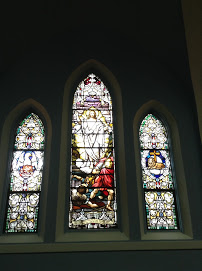
     Through the smoke, the chief noticed the church's 20 beautiful German stained glass windows and hated to think they might be destroyed in the effort to save the church.
     "I told them, let's not break any windows," Steinle said.  
Windows at St. John United Church
     

     As hoses were run out, Engine 43 hit the fire with its deck gun, pouring 500 gallons from its reserve tank — "quick water" as firefighters call it — attempting to knock down the fire while the hydrants were opened.
     That took longer than usual. The first hydrant was frozen — it was 11 degrees that morning — so Ron Szatkowski hustled to find another.
     Other firefighters rushed to find the quickest way into the church.
     "Churches have got those big doors; there's no way to get in there," Lt. Anthony Rodriguez said. "We had to go in through the window that the fire was coming out of. We put up ladders, and guys went up the ladders. It was a real dangerous situation. Churches are notoriously treacherous. They are full of secret passages and lofts. Firemen get up there and get lost within the ceiling. A real dangerous situation."
     Particularly for firefighters Angelo Rodriguez and Joseph Kish, crawling on a board at the peak of the church, in the false section between the plaster ceiling and the roof, dragging a 1 3/4-inch hose.
     "I went up with a charged line, crept up through the scuttle hole into the cathedral ceiling," Rodriguez said. "I was over the cathedral ceiling, inside the crawl space. It was hot, where we hit the ridge of the church's roof, and downward toward the wall. One false step and I was through the dry wall and about 50 feet to the floor."
     Meanwhile, firefighters Brad Wilson and Ed Datz scrambled up the slate roof, icy and pitched at a dizzying angle.
     Clinging to a roofer's ladder, they broke holes in the slate with sledgehammers, then chopped through the roof with axes to let the smoke and heat out, probably preventing the roof from collapsing.
     Busting the windows would have helped, too, but Steinle had given an order.
     "He saved those windows," Lt. Rodriguez said. "In the heat of battle, firemen do what has to be done. But the chief said that bad things would happen to us if we broke those windows."
     The ceiling was a total loss. Smoke damage stopped precisely at the top of the windows. Restoration took nine months and cost about a million dollars.
     Last Sunday, the congregation rededicated its building. And despite the firefighters' reluctance to be honored for doing their job, members of the 6th Battalion were on hand.
     "The minister is pretty persuasive," Steinle said. "We don't normally do things like this. We don't normally bask in the light. We're happy to save any building. But being an edifice of God, it made us feel good."
     How did Nold persuade the humble firefighters to come to her church to be hugged and honored? She put it in a way they couldn't refuse.
     "I talked to Chief Steinle and told him I wanted them to come, to thank them, and give a presentation," she said. "I could see in their eyes they felt shy. I said, 'We're a small, inner-city church. We work round the clock dealing with poor people, tragedies, chaos and the homeless. We need you to come tell my congregation that you cared to save the church.' "
     The firefighters — who received a unit performance commendation from the department— credit teamwork for saving the church.
     Nold has a different idea. She never worried that the church would be destroyed.
     "No, and I'll tell you why," she said. "I could feel the angels. I could actually feel the angels. I knew the angels were inside the church. I didn't think the whole church would burn. I knew there were too many angels in there. Both real angels, and the firemen, acting like angels."

        —Originally published in the Sun-Times, Sept. 14, 2000

     Postscript: I phoned the church to see if Rev. Nold is still there: she is, 27 years on the job. She did say that the facade of the church needs expensive repairs, and its future is uncertain. The plan now is to sell three of the four lots it sits on and use the money to build a new, smaller urban church on the fourth lot, of course transferring the German stained glass windows into the new building. 


Sunday, July 12, 2015

The cock crowed three times


     "Did the bird come first?" she said, under circumstances I will not relate, except to say that while I immediately knew exactly what she was referring to, I set the question aside to consider at a more apt moment.
     Which is now.
     I have an interest in the divergent meanings of words, and whether those meanings have a connection.  "Turkey," for instance, is a country, but it's also a bird, the connection being ... wait for it ... that when European explorers first saw turkeys, they thought them exotic birds, and the home of exoticness at the time was the Ottoman Empire, the way fancy fried potatoes became "French fries" because sophisticated grub comes from France.
     In previous posts, I connect rocket, the spacecraft, with rocket, the plant, while finding waffle, the foodstuff, and waffle, the act of indecision, trace their origins independently to the Netherlands and Scotland, respectively.
     So to the matter at hand: "cock." The main two definitions of "cock" are highlighted in George Carlin's "Filthy Words" routine that went all the way up to the Supreme Court in FCC v. the Pacifica Foundation.*
     "The word cock is a half-way dirty word, 50% dirty—dirty half the time, depending on what you mean by it," Carlin says, in the transcript of the case offered into evidence by the FCC. "Remember when you first heard it, like in 6th grade, you used to giggle. 'And the cock crowed three times!' Heh (laughter) the cock -- three times. It's in the Bible, cock in the Bible. (laughter) And the first time you heard about a cock-fight, remember—What? Huh? Naw."
     So how did "cock" come to be used to describe a barnyard fowl and a very different kind of pecker? 
     The definition of "cock" in the Oxford English Dictionary covers two full pages and begins, "1. The male of the common domestic fowl, Gallus domesticus, the female being the HEN.)"
     That usage goes back some 1100 years, to 897, to King Alfred's translation of Pope Gregory I's Pastoral Care: "Donne graet se lareow swa swa kok on niht."
     The second definition—"Figuratively applied to men" seemed to be the expected skirting of the issue, listing usage denoting various ministers, leaders, watchmen.      
     I assumed the mighty Oxford would blanche, like an elephant startling at a mouse, since that edition has no entry for "fuck." I didn't expect the OED to touch "cock" either. 
     The 12th definition seemed to reveal a willful ignorance:
     "A spout or short pipe serving as a channel for passing liquids through, and having an appliance for regulating or stopping the flow; a tap." True enough, but the analysis afterward baldly admitted, "The origin of the name in this sense is not very clear. The resemblance of some stop-cocks to a cock's head with its comb, readily suggests itself."
     Uh-huh. Elizabethan tavern owners called beer spigots "cocks" because they looked like a rooster's head. Well, yeah, it could be that, or maybe you're ignoring the obvious, some other object through which liquids flow.
     Other meanings follow, part of a plow, the needle of a balance, a bracket in clock making ... I had no hope, but was just being thorough. You can't say a meaning is missing unless you've checked it all. "The mark at which curlers aim." 
     Then, quite unexpectedly, the Oxford just blurts it out:  "20 = Penis." tracing the word back to 1737 and Rabelais, and nodding at its popularity among the unwashed masses. "The current name among the people, but, pudoris causa,** not admissible in polite speech or literature, in scientific literature the Latin is used. In origin perhaps intimately connected with sense 12." 
     So the Oxford, at least in the faraway era of 1978, speculates that the sexual usage for "cock" must have been borrowed from keg taps, which got that meaning from the shape of rooster heads.
     That's weak. I would form a stronger, alternate theory: that "cock" was used for the male organ all along, and then applied to male birds and spouting taps, where it first slipped into the historical record.  It's easy enough to find earlier usages that somehow eluded the OED.
     Cocks certainly pop up all through Shakespeare's plays, in the three main senses of the word. As birds yes, "The early Village Cock Hath twice done salutation to the morne" (RIchard III) and as spigots, "When every room hath blaz'd with lights, and bray'd with minstrelsy, I have retir'd me to a wasteful cock, And set mine eyes at flow," in Timon refers to retiring to a tavern.  
     But Shakespeare also uses "cock" in a variety of obvious double entendres, whether in Hamlet, in the ramblings of mad Ophelia ("Alack, and fie for shame!/Young men will do't if they come to'it, By Cock, they are to blame.") or in Henry V ("Pistol's cock is up, and flashing fire's to follow.") In the first sense it's a stand in for "God," and in the second, a cock was also the hammer of a gun  (hence guns being "cocked") 
     Samuel Johnson's great 1755 dictionary hints at the connection between the two types of pecker, defining "to cock" as "to set erect, to hold bolt upright, as a cock holds his head," and when we think of the actual barnyard fowl, heads thrown back, combs at attention, it isn't difficult to suspect, as I do, that the two meanings go back a long time, a theory supported in the copious scholarship on the subject. 
    "The relation of cock and phallus is ancient" notes Gordon Williams, in his 1994 A Dictionary of Sexual Language in Shakespeare and Stuart Literature, beginning his entry on the word. 
    At which point we should probably let go of the subject, lest we be drawn into the vast online  discussion of the word, the most interesting aspect being that "cock" was polite English until Victorian times, and that American squeamishness even replaced its avian and plumbing uses with "rooster" and "faucet," as a sort of guilt by association. My interest sagged reading a lengthy debate over  a 2500-year-old Greek phallus-headed statue of a rooster that may, or may not, reside in the secret collection of the Vatican. But I think we've handled this sufficiently. I'm a little sorry I brought it up.

   
* On Oct. 30, 1973, at about 2 p.m., New York radio station WBAI played George Carlin's 12-minute routine. It was heard by a father driving with his young son, who complained to
the FCC, which found "Filthy Words" "patently offensive" and wrote the station a letter of reprimand, warning that it could affect renewal of its license. A lawsuit by the Pacifica Foundation, owners of the station, followed. Emphasizing the "narrowness" of its ruling, the Court, in a 5-4 decision, found that the government has an interest in regulating the content of material broadcast on the airwaves, because "broadcasting is uniquely accessible to children, even those too young to read." Writing for the majority, John Paul Stevens explained, "Of all forms of communication, broadcasting has the most limited First Amendment protection. Among the reasons for specially treating indecent broadcasting is the uniquely pervasive presence that medium of expression occupies in the lives of our people. Broadcasts extend into the privacy of the home and it is impossible completely to avoid."

 *"Pudoris causa is Latin for "because it is shameful." 

Saturday, July 11, 2015

Saturday fun activity: Where IS this?


     This is one of those places where you are both lucky and unlucky to be.
     Bad that you have to be here.
     But if you have to be a place like this, better to be this place than many others.
     And I'll leave it at that.
     Business took me here, not personal matters, thank goodness.
     Which is not to take anything away from it.
     And besides, now I could never go at all.
     Which isn't as reassuring at it sounds.
     Anyway, where are these undulating aqua shapes? 
     The winner received one of my scorned 2015 blog posters, which I have in abundance.
     Place your guesses below.
     And good luck. 

Friday, July 10, 2015

Don't blame the Chinese, yet


     We teach kids the wrong stuff.
     Yes, multiplication is important. And you don’t want youngsters looking at a dollar bill and wondering, “Who’s the dude in the wig?”
     But we load students with too many dates, too many facts, too much Treaty of Ghent and not enough organizing concepts.
     Knowing a fact — the Civil War ended in 1865 — can be helpful in constructing an accurate view of the world. But knowing a concept helps you mold the countless facts encountered through life into meaning.
     If I had the chance to design a class for high school students, I would teach “Pattern Recognition.” Patterns explain so much: Why you wake up at night, startled, thinking the shirt you draped over a chair is an intruder. Why so many otherwise sane people believe the 9/11 attacks were the result of a conspiracy other than the actual conspiracy. Or why on Wednesday, when I saw that, in addition to United Airlines suspending its entire operations due to a computer malfunction, the New York Stock Exchange had also ceased trading, I tweeted two words: “The Chinese . . .”
     We connect dots, facts, and form patterns, some accurate, some illusional. United Airlines freezes up, Wall Street goes down, the Wall Street Journal home page too — obviously an attack — and China, causing computer trouble lately, the obvious culprit. The difference is, when officials announced that it wasn’t an attack, just coincidence, I accepted that. (Although, wouldn’t that be just what they would say, to avoid panic?)
     See, that’s what people do. They take a couple of data points and spin a story around it. That’s how the little pinpricks of light randomly jumbled in the sky became Orion the Hunter, Gemini the Twins, Queen Cassiopeia and such. Then we stick with that story, ludicrous though it be. Think of those constellations. All our technology, all the complicated history of the world, all the stuff we have to know now that shepherds 2,000 years ago didn’t have to know.
     So why does society still teach us the “W” in the sky is Cassiopeia — and I never bothered to find this out before — a Greek queen famous for her beauty? Whose vanity drew the wrath of the gods, which is why she is in that chair, the Earth’s rotation turning her upside down, punishing her.
     Heck, why not? The stars are always above — no glitches there — and separating them into little packages and giving those clusters personalities, well, maybe it makes the night less scary. We look up and see the Big Dipper, we recognize a pattern, like a friend’s face in a crowd. So not only do patterns alarm — the bear that isn’t there, the Chinese attack that wasn’t, apparently. But they also comfort.
     Technical disruption, temporarily and on a small scale, can be comforting too. Or at least a chance for a pause from routine. I like when the power goes out. We light a few candles and sit there, a routine evening turned into flickering drama. I’m sure after two days it would get old, but my power was never out for two days. Lucky me.
     Even computer crashes, annoying as they are, are also a reminder that this isn’t magic. It’s human agency. Robots won’t take us over; we’ll take ourselves over. The networks are all dependent on overworked, overheating server farms in places like Prineville, Oregon, and Weehawken, New Jersey, and right here in Chicago, where Microsoft has thousands of servers. Facebook has been wheezing lately, its data banks no doubt groaning under billions of users who all want to post video of their 4-year-old playing a bee in the school pageant. Facebook constantly crashes — “Aw, Snap!” Chrome’s error screen says — which was cute the first 20 times I saw it.
     I take Facebook’s sputtering as a karmic reminder that Facebook has peaked, and the less time I spend on it the better. We have to remember that all this online stuff is still relatively new and people are still figuring out how much of our lives to devote to it. I’m not suggesting the novelty might wear off. We won’t go back to pasting photos in scrapbooks or recording stock sales in ledger books. But we might decide to focus a tad more on the living world and a tad less on the Internet. It is possible. Isn’t it?

Thursday, July 9, 2015

Books on the nightstand: "Phineas Finn"

 
Morgan Library
   
Saving money isn't everything. There is also supporting local establishments which provide service and community that no web site could offer. So I make it a practice to shun Amazon, whenever possible, and stroll over to the Book Bin, my local book shop, to order the books I'm looking for. 
     I was in the process of paying for Alberto Manguel's "Curiosity," based entirely on a rapturous review in the Economist, when one of the Book Bin's friendly, helpful clerks, Allison, pointed out that I have been neglecting my "Books on the nightstand," section of the blog—a number of months have gone by. I apologized and told her I would get right to it. 
     That was weeks ago. And numerous times I meant to set down the novel reviewed below and report on it here. But I didn't want to pull myself away from reading it. As soon as I finished though, just last night, and while it is still fresh in mind, I want to use it to revivify the "Books on the nightstand" section o the blog, where I'll post this, and next week I'll tuck a review of Amanda Palmer's "The Art of Asking."


Phineas Finn,  by Anthony Trollope (Everyman, 1997)

    I don't read many novels, because they generally strike me as untrue. Whatever fantasy world is created is pallid compared with reality, the characters jerky with quirks and irrationalities, unbelievable puppets, compared to actual people, moving through an uninteresting tale.
    But occasionally a novel grabs me. 
    This was an improbable choice. Even Adam Gopnik's tribute to Anthony Trollope on his 200th birthday in the New Yorker in early May might not have prompted me to order it. I have an aversion to 19th century British novelists. I think I've read two Dickens novels, Great Expectations, in high school, and A Christmas Carol, several times, and as marvelous as those were, I was happy to leave it at that. 
    But Gopnik's 2008 essay on Samuel Johnson had set me off on a deeply satisfying journey into Johnson's vastly fascinating world, not only reading the biography he was reviewing — Samuel Johnson by Peter Martin — but tackling Boswell's epic Life of Johnson, a pure joy.
    So I figured, he didn't steer me wrong with the Great Cham of Literature; perhaps I should trust him here, too. 
     So into Phineas Finn, an 1869 novel about a young Irishman who is put up for a seat in Parliament, his world of ministers and functionaries, plus assorted characters such as Quintus Slade of the People's Banner, one of the greasier journalists  to be found in literature, approaching those in real life. There are alluring, strong women characters: Lady Laura Standish, wed to to the rigid Robert Kennedy, and the buoyant Violet Effingham.
    The romantic ... well, not a triangle, more like a pentagram, when you include Madame Max Goesler and Mary Flood Jones, his sweetheart waiting patiently back at home — did keep my interest, but I was able to march through its 650 pages mainly due to the book's political tone, which rang a most contemporary note. Here is Finn and his friend Laurence Fitzgibbon debating how a vote will fall between the Tories and the Liberals.
    "But the country gets nothing done by a Tory government," says Phineas.
    "As to that, it's six of one, half a dozen of the other," replies his Fitzgibbon. "I never knew a government yet that wanted to do anything. Give a government a real strong majority, as the Tories used to have half a century since, and as a matter of course it will do nothing. Why should it? Doing things, as you call it, is only bidding for power — for patronage and pay."
     That could be the Illinois government right now.  The cynicism of the book, 150 years old, is startlingly contemporary, such as when the hypocrisy of British leadership is painted as a good thing, at least compared to the sincerity of Americans. In Britain, rancorous Parliamentary debates end with the participants marching off arm-in-arm.
     "It is not so in the United States," writes Trollope. "There the same political enmity exists, but the political enmity produces private hatred. The leaders of parties there really mean what they say when they abuse each other, and are in earnest when they talk as though they were about to tear each other limb form limb."
Anthony Trollope
      The shabbiness of low level government is deliciously laid out by Trollope, who worked as a postal inspector in Ireland for years — some of Finn's friends express sincere condolences at the calamity of his election. But the higher levels fare little better.
     Here is  again is Fitzgibbon — who blithely reneges on a loan that Finn has signed for in an act of misplaced trust, causing Finn to be plagued by a colorfully dogged creditor — explaining the candidates for Prime Minister. 
     "There will be a choice out of three. There is the Duke, who is the most incompetent man in England; there is Monk, who is the most unfit; and there is Gresham, who is the most unpopular. I can't conceive it possible to find a worse Prime Minister than either of the three,— but the country affords no other."
     "And which would Mildmay name?" asks Phineas.
   "All of them,— one after the other, so as to make the embarrassment the greater."
    "Mildmay" points to one of the flaws in the book, Trollope's tendency toward illustrative names. There is the timid Mildmay, the radical Turnbull, the revered Duke of Omnium. Not quite Piers Plowman's wife, Dame Work-While-I-Am-Able, but uncomfortably close.  
     Still, I found myself eager to get back to the book, the mark of good fiction.  Trollope is a first rate writer, tossing off lines that should be epigrams assuming they weren't already when he used them: "But we all know how the man well spoken of may steal a horse, while he who is of evil repute may not look over a hedge." 
     Or, even better: "After all, money is an accident."
     Phineas Finn plunges readers into a world that is foreign — after Lady Laura flees her husband, the grim Mr. Kennedy threatens to go to law to drag her back — yet all-too-familiar. There's something reassuring about it. If our leaders are going to be dolts, at least we can comfort ourselves with the realization that we didn't invent the practice. The greatest recommendation I can give is that there is a second book, Phineas Redux and I am going to seek that out and dive in, just for the pleasure of hanging out with Phineas, Lady Laura, Madame Max and the rest of their diverting circle. It is summer, after all.