Showing posts sorted by relevance for query Seneca. Sort by date Show all posts

Wednesday, March 19, 2014

"A bad man makes everything bad"


    I could say that I stumbled on James Romm's new book about Seneca and Nero, but the truth is worse. I went looking for it, dropping into Amazon, asking, "I wonder if there are any good books about Seneca?" and was rewarded with his excellent book, "Dying Every Day," that starts out talking about images of Seneca, beginning with what we now call the "Pseudo Seneca," discovered in Herculaneum in 1754. It seems that people just assumed it was Seneca, because there were so many images of the man, and his gaunt features seemed to reflect a life spent according to Seneca's stoic philosophy.
Real Seneca
Pseudo Seneca
      It was only in 1813, when this well-fed bust was discovered, boldly labeled "Seneca" that everyone realized—duh—a plutocrat at the court of Nero would probably look like this guy. Romm uses the portraits to great effect in the beginning of his book.  Given the wide gap between Seneca's preaching and his practice, the business with the busts is the sort of delightful symbolism that would look hokey in fiction, but feels just right in life.

     When multimillionaire Bruce Rauner, now the Republican candidate for governor, speaks of his humble roots, flipping burgers and parking cars, he is employing a very old rhetorical device.
     Resentment is a powerful force in politics, so it’s always better to be seen as a common man climbing up than a rich guy stooping down. Take Lucius Annaeus Seneca, the stoic philosopher of 1,950 years ago, constantly pooh-poohing the importance of money, shrugging off its relationship to happiness, lauding the simple life of cold, dark baths and earthenware plates. He was also one of the richest men in Rome, Nero’s tutor, the recipient of fortunes that once belonged to those the teenage tyrant impulsively killed.
     “I never call him a hypocrite,” said James Romm, whose book on Seneca and Nero, “Dying Every Day,” was published this month by Knopf. “I quote Robert Hughes calling him that. I find that a bit harsh.”
     Perhaps. Then again, Seneca lived in a harsh world, as his essays, some of which deal with the importance of holding up calmly under torture, amply illustrate. 
     I phoned Romm, a professor of classics at Bard College, to talk about Seneca because, really, how often does a guy get the chance? Most people I know draw away in head-shaking revulsion if I mention the classics, as if reacting to some mix of dullness and pomposity. To me, they offer useful ideas. They’re practical. It’s as if you came upon a friend trying to assemble a bicycle with his bare hands and said, “Have you considered using a wrench?” only to have him scoff, “Ooh, a wrench! Aren’t we fancy? Going about using tools. Let’s all sit on the veranda and eat scones and talk about our wrenches.”
     I’ve been working my way through the eight-volume Loeb Classical Library set of Seneca because his approach to life is so sharp. “A bad man makes everything bad, even things that appear to be what is best,” he writes. “But the upright and honest man corrects the wrongs of Fortune.” Or tries to.
     Romm focuses less on Seneca’s philosophical writings and more on his survival at Nero’s court, where hypocrisy was not only useful but mandatory.
     Maybe “hypocrisy” is the wrong term. In the complexity of life, you need to be nimble. With Seneca in mind, it might be unfair to say to Bruce Rauner, “So … you have no experience at government at all. Zero. Which you claim, rather brashly, is your central attraction. How does that work in business? If I apply for a position in one of your companies, can I seal the deal by saying, ‘And best of all, I’ve never been corrupted by actually attempting any of the work you do?’ ”
     Perhaps saying one thing and doing or being another isn’t so much hypocritical as flexible, putting our best face forward. It isn’t reasonable to expect Rauner to include among his TV ads clogging the airwaves one that shows him standing in front of one of his nine mansions and country homes, saying, “Hi, I’m a graduate of the Harvard Business School who spent the past 35 years lining my pockets, utterly detached from you and your problems. But now I’ve decided to swoop in and run Illinois.”
     Concerns of Seneca’s still resonate today. “Roman society in the first century AD is very recognizable,” said Romm. “Concerns about love and money and life.”
     What I didn’t realize until I read Romm’s book is how Seneca’s letters are similar to tweets and blog posts. He didn’t just write them for one recipient but for general consumption, and usually with specific political purposes.
     “He could get away with things because he could portray them in print in a way to make it acceptable,” Romm said.
     The pressing question for Seneca was whether to stick with the unstable Nero and try to soften his crimes while becoming party to them or flee for his life. Like most at the trough, he rationalized a way to stay.
     I asked Romm if he thought Seneca made the right decision. “He didn’t really make a decision at all,” Romm said. “That’s one of the most troubling things about him. He went along, hoping for the best, not taking a lot of action either to change Nero or to get away from him. He sort of waited for better cards to be dealt and they never were.”
     Gosh, that sounds familiar.
     “He knew he couldn’t live up to his own ideals,” Romm said. “Does it diminish his words? Yes, I think so, but it also makes him a very recognizable figure. Like most of us, he couldn’t be as good a man as he knew he wanted to be. It makes his tragedy under Nero all the more poignant.”
     Romm is referring to Nero forcing Seneca to … well, I don’t want to give away the ending. You should read the book. But Bruce Rauner, take note: Being rich isn’t enough.

     Photo atop blog: a bust of the Pseudo Seneca in the library at the University Club on Monroe Street. 


Tuesday, September 3, 2024

"You must live for others"

Bust of Seneca at the University Club (actually, the "pseudo Seneca," as I discuss in a post 10
years ago. The real Seneca, a rich man at the court of Nero, was far chunkier).

   MAGA types coined a term, "Trump Derangement Syndrome" to describe those who, in their estimation, focus too much on the man who was recently the president of the United States and will be again if we're don't fight hard against him and maybe even if we do. 
     While, like so much of their rhetoric, TDS isn't real, but just a negative term attached to something which is in fact positive — caring for your country intensely and wanted her not to be run by a demagogue and madman is a good thing. Yet sometimes I wonder if I'm not seeing Trump in places where I ought not to.
    For instance. The Roman philosopher Seneca does not write about current events. He killed himself on orders of his former student Nero, speaking of deranged tyrants, in 65 AD. Yet I was reading his Letter No. 48 on Monday (hey, don't judge me — it's a free country, for now; we may still read what we like) and came upon this:
    "No one can live happily who has regard to himself alone and transforms everything into a question of his own utility."
    And I heard, "Trump," as clearly as if someone in the room had spoken his name. The guy never seems very happy, does he? It's his own boundless and inflamed ego, an insatiable hunger to be the center of all things, eating himself alive. Then Seneca offers up what could be a precise, dozen-word synopsis of the liberal mindset: "You must live for your neighbor, if you would live for yourself." (In Richard Gummere's 1917 translation of "Alteri vivas oportet, si vis tibi vivere" in volume 75 of the Loeb Classical Library. A more updated translation would be, "You must live for others if you want to live for yourself.")
    I might have left that be — if I wrote about every noteworthy passage I find in classical literature, it's all I'd ever do. Then Seneca sets the stage for the 2024 election:
    "Lo, Wisdom and Folly are taking opposite sides. Which shall I join? Which party would you have me follow? ... The one wants a friend of his own advantage; the other wants to make himself an advantage to his friend."
     It is shocking that this choice is still a head-scratcher for many Americans, but Seneca dives right into that: "It is clear that unless I can devise some very tricky premises and by false deductions tack onto them a fallacy which springs from the truth, I shall not be able to distinguish between what is desirable and what is to be avoided!"
     Bingo Lucius (Seneca's first name). 
     He urges his friend not to turn his back on others:
    "Men are stretching out imploring hands to you on all sides; lives ruined and in danger of ruin are begging for some assistance; men's hopes, men's resources, depend on you. They ask that you deliver them from all their restlessness, that you reveal to them, scattered and wandering as they are, the clear light of truth. Tell them what nature has made necessary, and what superfluous; tell them how simple are the laws that she has laid down, how pleasant an unimpeded life is for those who follow these laws, but how bitter and perplexed it is for those who have put their trust in opinion rather than in nature."
    That last part surely overstates the case. You can respect nature and observe law yet somehow not enjoy a "pleasant and unimpeded life." But still, grist to chew on in 2024, doubly impressive in that it was written nearly 2,000 years ago, found in a book first published in 1917. Lies curdle quickly — that's why Trump has to keep spewing them, to replace them as they fester and fall apart. The truth never grows old.


Saturday, October 26, 2024

Cede fortunae.

   
          "The Death of Seneca," by Jean Guillaume Moitte (Metropolitan Museum of Art)


     Seneca is dead. Needless to say. By his own hand in 54 AD. On order of his former pupil Nero, "some of whose worst misdeeds he did not prevent," in the words of a flap copy writer at the Loeb Classical Library, a phrase that should disturb any one of numerous politicians and billionaire newspaper owners groveling before a more recent tyrant. If only they could, you know, be disturbed by criticisms of their actions.
     But Seneca can spring to life, thanks to his writings. And recent events being what they are, I returned to the conflicted, contradictory epicurean philosopher, starting in on Volume I — Moral Essays.
     As always, I found grist for thought aplenty. In "On Providence," he discusses how the hardships men endure increases in direct proportion to their worth. Quanto plus tormenti tanto plus erit gloriae. "But the greater his torture is, the greater shall be his glory." Uh-huh. Pretty to think so. Spoken like a rich and powerful man who spent his time relaxing in mineral baths at his luxurious country villas. Seneca was a big fan of standing up to abuse — for others, in theory. I don't quite buy it.  
     He does offer an appealing image of fate as a dutiful father. What does a caring parent do for the education of sons? Rouse them from bed painfully early, set them to hard tasks and difficult studies, all for their future betterment. So fate harries and harasses her favorites. "She seeks out the bravest men to match with her ... those that are most stubborn and unbending she assails." In order to shape and improve them. 
     Seneca says that kind of thing a lot — what's the point of being a good, strong person if you never get the chance to show off what you've got? Affliction is a celestial compliment. Gee thanks.
     That is page 21. But on page 233 I came upon something more persuasive, or at least more useful to my current mode of thought: cede fortunae. "Submit to fortune." You have to — what choice is there? Denying fortune doesn't really do much good. Some things can't be changed. Why rail at the inevitable?
    Cede fortunae. Looking at the Latin, it reminds me of one of my favorite lines in the classics, Virgil's tu ne cede malis. "Yield not to evils." Book VI of the Aeneid. Which leads to the essential dilemma: is this fortune's will, to be accepted, or a wrong to be battled? 
     Hmm...good question. How to tell? It's really a restatement of the Serenity Prayer: "God grant me the serenity to accept the things I cannot change, the courage to change the things I can, and the wisdom to know the difference."
    That can be a tough call. Sometimes something can seem bad but ultimately be good — I use the example of anti-Semitism in Poland in the 1920s. Bad for the people there, generally; good for my grandfather, specifically, since it set him on the road to the United States, so that when Holocaust took place, he was dandling my mother on his knee in Cleveland. Luckily he went where fate blew him.
     I try to keep that dynamic in mind when seemingly bad things occur. A certain development appears bad now. But might it not yield up something good, if I respond in the right way? Might it be, not a setback, but a benefit? A journey? You don't always want to go somewhere, particularly when forced: here's your staff, your hat, get going. But having no choice, you set out on the road, and suddenly you're seeing things you would not have seen nodding at home by the fire. Maybe the setback is really an adventure in disguise. Let's hope so.

Wednesday, January 16, 2019

The ancient Romans knew how to handle Twitter better than we do


     “Pusili hominis et miseri cum est repetere mordentem,” Seneca writes, in his essay on anger. “It is a petty and sorry person who will bite back when he is bitten.”
     That’s a little strong. While I hesitate to disagree with the master, I have to. Yes, smallness and sorriness define retribution, as they define much of the anthill we call human existence.
     But there is also a strength to biting back. Someone flips you the bird, you automatically return the gesture. Laudable? No. But it does show pride.
     Standing your ground is a reflex, no doubt traced back to baboons on the savanna fluffing their fur to look bigger. The question is: Is it a reflex we can afford to indulge in our social media age? Because we certainly do, big time. The biters and the bitten, toe-to-toe, blasting away.
     Consider how much human effort, brainwork, emotional frisson, not to mention typing, is spent in online disputes. Billions of times a day, total strangers conducting their snarling, personal-yet-anonymous broomstick sword fights.
     Toward what end? Are we debating? Having a conversation? Or merely flailing at each other?
     Who benefits? Twitter, Facebook and the social media companies certainly do. We, not so much. We are unpaid gladiators performing our tiny verbal combats for their profit, so others can read the advertisements between our spats.
     Writing for a daily metropolitan newspaper, I receive blowback continually on all platforms. Letters and phone calls, Facebook posts and email and Twitter.
     That’s good. I want reaction. I used to read them all, reply to them all. But lately that practice is starting to seem antique, like a 19th century president meeting with whoever turns up at the White House and asks to see him.
     My motto used to be Warren Zevon’s line, “The name of the game is be hit and hit back.” Now my mantra is: Don’t let the poison in. Don’t read negative emails, never mind react. Bail out as soon as the language sours. Block and forget. It isn’t as if the person writing is open to persuasion. That’s so 1980s.

     With emails, my approach is similar to how the law treats dogs: the first bite is free. I read everything new. People who bring up valid points, who identify actual mistakes, who disagree without an excess of contempt, are responded to in kind.
     Well, at least the first line of everything new. People who start with a blast of scorn don’t merit further consideration. Why waste the time? I don’t write for people who hate me; as to why people who hate it keep reading, well, who knows?
     Silence is an answer, often the best answer. Shutting up, I like to say, is an art form. You have to practice to get good at it.
     Somewhere along the line, ignoring nastiness online got a bad rap. Twitter trolls created the notion that to be a vibrant person you need to crawl into the mud with any stranger who invites you. That’s ridiculous. You don’t do that in life. Someone flips you off in traffic, you don’t both pull over so you can exchange obscene gestures for 20 minutes, at least not if you’re smart. Why do it online? Besides, there are too many of them and only one of me. I block everyone on Twitter the moment they turn ugly. If they consider that a triumph, great, they probably need one.
     If you don’t believe Seneca about the smallness of biting back, read Donald Trump’s twitter feed. Pouring contempt on whoever is in the headlines and not his fan — Jeff Bezos getting divorced (“So sorry to hear the news about Jeff Bozo being taken down…”). No target is too big or too small for the president of the United States to ridicule.
     That’s not a sign of power, but evidence of enormous weakness.
     In his essay, Seneca mentions mice and ants, which bite if you reach for them.
     “Feeble creatures think they are hurt if they are only touched.”
     That describes a lot of people nowadays, doesn’t it?
     Don’t be like mice and ants, but men and women. Don’t lash out at those lashing at you.
     “He is the better man who first withdraws; the vanquished is the one who wins,” writes Seneca. “If some one strikes you, step back.”
     That’s a plan.

Monday, December 25, 2017

Aire Ancient Baths brings Roman luxury to River West


     When I wrote about "111 Places in Chicago That You Must Not Miss"—the column where I go to Englewood to get a cup of coffee—I spoke with its author, Amy Bizzarri. We talked a bit about Red Square Spa, and she mentioned this new Greco-Roman bath that had just opened, too new to be included in her book. I asked her if she planned to write about it, and she said no, so I snapped it up. That's TWO columns I've gotten from her. Thanks Amy.

     What do Chicagoans have in common with ancient Romans?
     Beside living in a crumbling empire ruled by an unstable tyrant, that is.
     Well, we've got our own Roman bath now.
     Aire Ancient Baths Chicago, 800 W. Superior, opened late last month.
     Doing my due diligence, I noticed something surprising: The Tribune, Crain's, Chicago Magazine, TV stations, all noted that a Spanish company was opening a 20,000-square-foot bath complex in the basement of a rehabbed 1902 paint factory in River West. Then all overlooked one vital step in the journalistic process: The actually going there part.
     As a former card-carrying member of the Division Street Russian Baths, I sensed an opportunity, and visited Aire last week.
     But not before getting in the spirit by reading Seneca's Epistle 86, where he discusses Roman baths. Seneca habitually praises the simple life, as only a fabulously wealthy man can, and so lauds the rustic baths of yore, with their chinks admitting light, so superior to the marble splendor of the baths of imperial Rome, with their big mirrors and fancy windows.
     Seneca's scolding, combined with Aire offering a $450 bath in Spanish wine, inclined me to expect over-opulence. A place for Trump-era plutocrats to percolate away their excess cash.
      So I was pleasantly surprised, walking in, to discover Aire has found the sweet spot between spartan and excessive. The tone is not gilt but exposed brick and rough-hewn beams. You are assigned a white glass locker, change into a bathing suit — it's co-ed — and little black water shoes, then plunge into the bath complex.


To continue reading, click here. 

Wednesday, July 1, 2015

Memo to Kraft Employees: Courage


      A decade ago, when the New York Daily News ran my column, I would fly to Manhattan to root around for material. Taking a break from working here, I'd go work there, an irony that was not lost on me.
     "What kind of idiot," I wondered, aloud, looking up from my keyboard in a windowless office, "takes his vacation from being a newspaper columnist in one city to go be a newspaper columnist in another?"
     That would be me. We not only love our jobs, we become our jobs. Which makes sense, since we do them so much.
     To even contemplate losing those jobs is hard. It's like thinking about dying. Worse, because when you die, you're no longer here. Your woes are few. But the unemployed have lost their livelihoods — a freighted word — yet continue to live these suddenly frantic, diminished existences, dog-paddling in the frozen slurry of the jobless, desperately looking for a ladder or a rope out before they drown financially and emotionally.
     During the past decade of recession that risk is a palpable menace for many, a thing in the bushes, sometimes quiet, sometimes growling. Thousands saw the dark thing stir reading the June 29 Crain's, whose front page story is on the mass firings coming to Kraft, which is merging with H.J. Heinz next month.
     "The layoffs will be swift, proceed in waves and cut deeply," Peter Frost writes in a story that must be twisting guts among Kraft's 22,000 workers, nearly one-third of whom can expect the ax.
     Since sarcasm is so common in this business, I should stress that I am not gloating. My heart breaks for those Kraft folk, happily selling cheese and pickles and salad dressing. The company is based in Northfield, not far from my house. I pass the headquarters all the time; it seems so sprawling and secure, like a college campus or a military base. A newspaperman expects to live a haunted existence but there's no joy in realizing those selling Jell-O are also crouched on shifting sands. Is no one safe?
     The shadow of the destroyer approaches Kraft. What does an imperiled employee do? Scan the horizon for a new job. Not a lot of sails there. Clear the decks. Cut expenses. Batten down hatches. Prepare for the storm.
     Then you wait, the low level terror of uncertainty eating at you. What to do? How to brace, mentally? Look back to the person you were at 17. What would that idealistic teen think of you now, in agony at just the thought of being cut loose from the Miracle Whip team? Gather your courage. I believe it is not the financial instability, bad as that is, so much as the blow to our identity that we fear most. To fight that fear, remember that we are many things beyond our jobs: husbands and wives, brothers and sisters, sons and daughters. Parts of us that can't be taken away with a memo.
     You need to practice pumping yourself up in the way your job does now. When the atmosphere of your corporation is gone, you'll need to exist in your own little spacesuit of self. It can be done. Seneca has two relevant thoughts. First, do not run ahead to embrace woes. They may never come; then you're worrying about nothing. Or if they do come, then you suffer twice, first in anticipation, then in realty.
     Second, view it as a test of your mettle. Seneca asks: What's the point of being a good, strong person if you never face difficulties? Do you really believe that you are only able to cope with life when it goes well, when the paycheck ka-chings into your account and the head of the Shake 'n Bake group singles you out for praise?
     The Daily News sacked me out of the blue. They never even told me I was fired; just stopped running my column one day. I found out when puzzled readers asked where I had gone.
     It still hurt, even though I still had my regular job here to fall back on. Maybe that's my advice to Kraft employees. Start stuffing that mattress with savings, with job applications, with freelance work, with spiritual enrichment. Something to make the stone floor less hard when you hit it. Seneca be damned, I've been preparing too. At least I've come up with a line.
     When a flailing axe gets to me again someday, I plan to smile enigmatically and say, "Now I am rich in time."


Sunday, December 19, 2021

Come and get me, COVID


     Is it me, or have things kinda ... shifted the past few days? Slipped, degraded, deteriorated, soured. 
     Thanksgiving was here, and it was busy and great. The day after omicron showed up and suddenly, wham, better and better suddenly became worse and worse. Even those of us with our three shots — vaccinated and boosted and ready to rumble — pretty much have nowhere to go. We lost our horizon, as I like to say. Suddenly the clear skies grew murky. Again.
     Okay, that's melodramatic. A lot of that, too. Drama. Things are not so bad, at least for me. Just last weekend, when I dwelling darkly on how we weren't going anywhere or even having the prospect of going anywhere, I decided, "Heck, fuck it" and told my wife, we've got to get out of here, if only into the city. Chicago is right there, let's poke around, as much as safety allows. She'd never been to the National Museum of Mexican Art in Pilsen. Let's go, let's grab some lunch first. So we made reservations at a nearby restaurant—5 Rabanitos, about two blocks away—and headed out for lunch then the museum.
     That was a good call. There was nothing wrong with me that a good avocado, scallop and shrimp ceviche couldn't fix, followed by honey-glazed chicken and roasted vegetables, washed down with a horchata. Food helps.
     The Mexican museum is really an under-appreciated wonder. Colorful, provocative art, particularly the COVID-themed Day of the Dead exhibit, which I wrote about when it opened.  Art helps. 
I have to share George Rodriguez's "Mictlantecuhtil Offering," above and below, with its friendly little skulls and bottles, not of vaccine, but of COVID.
     Mictlantecuhti, by the way, is the Aztec Lord of the Dead. Fearsome, but also friendly. At least in this representation. Which makes sense, since it is not so much death that we are afraid of, that is rattling us, most of us, but how the rampaging illness is constraining of our lives. We aren't used to hardship. It's hard. But that's okay. Because we're strong people, and what's the point in being a strong person if you never get the chance to show of your stuff?
     That's not my original thought, it's Seneca's, digested years back and spewed forth now. But it fits. COVID is either never going away, or at least not going away anytime soon. So the trick is to neither lose our lives, by dying of the disease, but also not by so constraining our existence that we might as well be dead. Of course you have to get your vaccines and mask up — not for yourself so much but for the benefit of other people, an aspect that seems to never even occur to a lot of idiots.
     But you have to also grab food and fun where you can. Live while you are alive — which is also not me, but I can't place who said it. 
     This started out bleak, because honestly, with the early dark on Saturday evening, I felt pretty bleak. But you can be plenty bleak on your own, without me piling on more desolation. So I figure, skew into the light. No matter how long this lasts, most of us are going to be fine. So let's be fine. Or try to be.


Wednesday, November 13, 2013

The map of time


     I'll probably never know who left this book on the river wall along Wacker Drive, just where it stops going west and begins turning south (or, I suppose, where it stops going north, coming the other way, and turns east).
     Nor will I know why it was left there, exposed to the elements, for quite a while by the time I came by — far beyond any rescue. It was chilling, to see a book so abused. No doubt the product of carelessness, though it did seem to symbolize something larger, a place we are approaching in our society.  Already we've seen books sold by the pound, or with their covers ripped off and bundled with twine as some interior designer's daft idea of decoration. You walk into Half Price Books, and just sense that printed books are worth less. Not worthless, not yet anyway. But worth less than even a few years ago.
     I'm not going to lament the printed word — the electronic word will carry on just fine, just as we can still fill up our cars without gas station attendants. Seneca pressed his words in wax with a stylus — the original meaning of "book" was "writing tablet" (a very old, Teutonic word, The Oxford English Dictionary speculates that "book" and "beech" share a root, and that perhaps the tablets were made from the bark of beech trees). 
    In other words, the manner of writing has always changed, so let's not get too bent out of shape that the process continues. The words remain. The influence of the printed word will continue as countless ghosts in the electronic machine, just as the chapters of books now are thought to reflect the individual scrolls that were once gathered together into "books."
    It can be argued the form doesn't ultimately matter. It is what is being said, not the medium it is being said in.
    That is mostly true. But not entirely.
    The form had value. The drawbacks of books — expensive to print, unable to be corrected — were also their glory, also exactly why they were cherished. Scarcity creates value, and you couldn't get a copy of "Moby-Dick" everywhere you go. Now you can. The reason so much time and effort was put into making books as good as they could be (Sometimes. Let's not overstate the case) is you can't correct them. You have to get them right, because they are supposed to be around for a long time. Were supposed to be around for a long time. Now they're raw material in art projects and, I assume, someday, fuel.
      Books will migrate entirely onto pads and phones and what have you, but it will not be the same, and hybrid forms will quickly emerge that better use those mediums. People will enjoy whatever we call the new art form — maybe "books” still, the way we call the control panels on our cars "dashboards" even though there is no horse to dash and kick up mud. We will still be moved by them, and will look at our paper books with puzzlement and disinterest, the way people today look at player piano scrolls and stereopticon slides.
     They also have flaws. Books don't hold up well to the elements, for instance. Of course, they don't break apart when dropped, either. Different technology, different advantages and drawbacks. But technology can't be fought. Technology wins, eventually.
     The book, by the way, was a novel by Felix J. Palma called The Map of Time. 


Thursday, February 1, 2024

And you shall anoint your beloved with cheesecake

     February already. Which means that Valentine's Day is ... two weeks away. And you have done ... nothing, right? No idea what special to do for your beloved. That's okay. Well, sad, but also okay, because I am here to help you.
     And a good thing, too. Because left to your own devices you would ... what? Merely buy something. Something random, last minute. A trinket. Some thoughtless cheap crap that will indict more than delight. What a sad commentary on both you and your love. Or would be, if I didn't save you. Which, luckily, I will. 
     Instead of doing something half-considered, why not go to trouble and expense while telling a story old as time?
     Why not be inspired, by how, two thousand years ago, the ancient Romans had trachemata — "second tables" — that were set aside for what we could consider "dessert." Laden with pancakes, sesame seeds, wine. The Greek playwright Diphilus lists a few delectables: "some myrtle berries, almonds, a cheesecake."
      Cheesecake? But what sort of cheesecake? Here the glozing hand of history is kind to us. Cato the Elder sets down no fewer than three distinct cheesecake recipes in his De Agri Cultura, a guide to managing estates written 2200 years ago, Eugenia Ricotti calls Cato's favorite cheesecake, Savillium, "the oldest known dessert" in her Meals and Recipes from Ancient Greece and claims it was found in the tomb of Ramses IV in the Valley of the Kings. First you mix 14 ounces of ricotta cheese with one and a half cups of flour ... actually, it gets rather complicated. You need a cookie press or pastry bag, plus boiling fat. 

     Far easier to simply order an Eli's Cheesecake. You might have noticed the festive holiday ad at the left of my EGD home page. But if that choice is overwhelming — so many kinds — let me draw your attention to the Belgian Chocolate Hazelnut Heart, perfectly shaped for the holiday. Look at it. You could drive yourself crazy trying to make that. You could hole up with your Cato, translating from Latin, messing with jugs of olive oil and such.   Or you could plan ahead and have it tucked away and ready in your freezer Feb. 14. "Rich chocolate cheesecake topped with a crunchy hazelnut and chocolate confection, baked on a chocolate cookie crumb crust in an elegant heart shape." How could it not be received with gratitude? Who does not want to love with similar dark intensity? Or one of my favorites, the Salted Caramel Cheesecake, if only for how it echoes Homer, who in The Illiad praises "the sacred offering of the salted cake."  Of course the Romans took cheesecake from the Greeks, along with so much of their culture, including this holiday, Cupid being the Roman version of the Greek god Eros. 
     Salted caramel not your style? I recommend the Basque Cheesecake, its burnt parchment wrapped evocative of the rough simplicity that wealthy Roman philosophers like Seneca paid lip service to, along with simple baths and unadorned pottery. 
Red is the color of Valentine's Day — which began at the tail end of Roman times, first set on Feb. 14 to honor the martyred Saint Valentine by Pope Gelasius in 469 A.D., just before Rome fell and the last emperor, Romulus Augustulus, was deposed ... anybody? Do they teach you nothing in these schools? ... seven years later, in 476. So you can't go wrong with Strawberry-Topped CheesecakeJust look. Are these not the "flame-red berries" Virgil lauds in Georgics? Or Cherry Vanilla Bean Cheesecake. Just say it out loud. "I love you, and so bought us this Cherry Vanilla Bean Cheesecake for us to enjoy together in bliss. "A thick layer of housemade Montmorency cherry filling and Madagascar vanilla bean cheesecake, topped with tart cherry gelée, baked on an all-butter shortbread cookie crust." 
     I know what you're thinking: "Neil, was not Cato the Elder something of a prude?" Yes, you are correct, no doubt remembering Pliny's Life of Cato, particularly this passage:
     Cato expelled another senator who was thought to have good prospects for the consulship, namely, Manilius, because he embraced his wife in open day before the eyes of his daughter. For his own part, he said, he never embraced his wife unless it thundered loudly; and it was a pleasantry of his to remark that he was a happy man when it thundered.
     Does that last part not contain a mischievous twinkle you could appropriate and present as your own? And a private setting is entirely fitting to the holiday. Why go out to a restaurant, on amateur night — prices up, service and quality down — when you could enjoy Eli's Cheesecake in the secluded bower of your home? 
     You could mention, opening the box, that Cato's libum was a savory cheesecake intended to be an offering to the gods. But that, like Prometheus stealing fire from the workshop of Hephaestus,, you have spirited this divine dessert away from its home on Mount Olympus and brought it here, now, for you both to enjoy on earth. Let eagles rip your liver for all time as punishment. Your loved one is worth the sacrifice....
     Okay, maybe that's corny. Maybe it's better to say nothing. Maybe you should bear in mind Cato's famous dictum: "He is nearest to the gods who knows how to be silent."
     Wordlessly remove the cheesecake from its sturdy cardboard freezer box and set a perfect slice on your best plate. Take one fork yourself, hand the other to your soulmate. Or better yet, skip the forks. Lock eyes with your adored one and whisper that the ancient Romans, whether soldiers or slaves or senators, would eat with their hands. Give yourself and your heart's true passion permission to do so now in celebration of your timeless bond and Valentine's Day, and let nature take its course.    

Saturday, February 27, 2016

Memento mori


     Death caressed my cheek, lightly, and in the oddest way.
     It was not precisely a caress, his cool fingers trailing across my skin, chilling me, and then gone.
     Not that. More like a sudden sting. Thursday night iPhoto ate my photos. All of them. Going back to 2009. Thousands of them. Gone.
     I don't know what happened. One moment I was working on my computer, getting my post for Friday ready, and I slid over to iPhoto to look at the pictures, and there were none.
     Just a grid of gray squares, empty as the eye sockets of skulls, jeering skulls, leering at me.
     Where are your precious memories now?!?
     I leapt online. There are forums for this—none sponsored by Apple itself, oddly. But a variety of ad hoc advice blogs run by would-be experts. It's as if Honda didn't print an Odyssey owner's manual, just left problems for drivers to form ragtag groups and puzzle over like Platonic dialogues, wordy and digressive.
     Nothing they suggested, once I figured out what they were suggesting that is, actually worked. I held down the "Option" and "Command" buttons while summoning up iPhoto, checked the "Reconstitute Thumbnails" button, and waiting in hope.
     But nothing. Shut down the computer and re-started it.
     Nothing.
     I wasn't upset so much as focused, determined. I figured the photos were somewhere. I would most miss the ones from the 2009 trip with the boys out West. But those would still be on the chip from the camera, which I saved.
    I explored.  I found a file with all of 2009 in it—1200 photos—and imported those back. The trip, ironically, the one thing I had backed up. But at least something, a scrap of the original bounty. Maybe a reason to hope.
    Then I saw something called "BROWSE BACKUP." And it brought me to what seemed like photos, on the teraflop G-Drive external hard drive I bought over the summer when my iMac's guts were dying. I hit "RESTORE" and got a little spinning candy cane and the hopeful message, "REBUILDING LIBRARY." It seemed to grow very slowly — a good sign. Something was happening. I went to bed.
     I snapped up at 3:30 a.m., rushed to check. The photos were all back. No, not all. It stopped in June, in the middle of Kent's prom. For some reason, the past seven months weren't there. Maybe I hadn't backed it up since then —I have a tendency to unplug the drive. There aren't enough ports for a drive and a printer and to charge the phone.  But I thought I had.
     I went to work musing on this, the loss of the past six months. What, exactly, was gone? I was almost afraid to think about it, to reaching into the void and feel the phantom prick of something important. What picture would I miss?
     It was then that I felt The Grim Reaper, the chill touch, the low chuckle as I walked through all those strangers in the Loop. The pictures for the past six months were gone, as all the pictures would be gone, as I too would be gone, the way your most cherished objects end up sold for a dollar at a garage sale, your favorite shirt a tuft of color on a bale of rags being shipped by the container to Africa. We assemble these careful worlds, our mementos under glass domes, our photos tagged and properly backed up, in albums trimmed with lace, then Fate draws in a big breath and blows and it all scatters away. Your memories molder in a landfill, or are gazed at by distant descendants who didn't know you and don't care.
    Embrace your losses, Seneca says. View them as practice. A few drops in advance of the storm that is going to wash you away. A reminder: someday you will lose everything.  Find a lesson. Keep that external hard drive plugged in.
      Patek Philippe is right. We never really own things, we just take care of them for the next generation, and while there's a chance they'd value your $100,000 wristwatch, most of us don't have one of those, and the threadbare assemblage we spend a lifetime gathering makes for a few melancholy days in front of a dumpster for our progeny. We only possess one thing that is truly ours: time, the minutes and days and hours of our lives.  And that we have in both scarcity and abundance. An endless, or so it seems while it is unspooling, string of moments that are really just one moment, now, blundering alongside us like an eager puppy into the next moment, some good, some bad, too many spoiled and wasted and tinctured with anxiety over something like the loss of some bundles of well-organized electrons.
     Back at my desk, I couldn't help it. I thought about the photos since June. There really was only one that came to mind as a Loss. Kent, on the day we dropped him off at Northwestern, running through the Weber Arch. My wife and I positioned ourselves further along the path, and I caught him as he flew past, young and happy and in motion, literally running toward his future. I'd miss that photo if I never saw it again.
    Although.... Did I not like it so much that I posted it as a cover on Facebook? Yes, I did. We sneer at these technologies, and blush at our use of them, but they do have their value. A click delivered it safe in a grey strongbox at the bottom of my Facebook page. So not everything lost. A little, sometimes the best, remains — maybe the best is what lingers. Or perhaps I'm just returning to the illusion. Lucky me was lucky again. The best photo is here, the rest will be found or, if not, forgotten, which is their eventual fate anyway. The Pale Rider brushes past me but keeps going, galloping toward a rendezvous with someone less fortunate. Leaving me with a souvenir, the briefest touch on the cheek, a cold kiss of fingertips that caught my attention, left me gazing at where he vanished, wondering whether I really saw him at all. That's a gift better than photos, to realize, there is stuff, and there is time. Don't waste the important one worrying over the unimportant one.  Thanks for the warning, Mr. Death, I'll try to take it more to heart between now and when we meet again.


    Postscript: After work Friday I took a longer look at that "Browse Backup" function, and recovered all the photos until Thanksgiving. We'll accept December and January's photos as the slightest of scars, nothing to even feel bad about. The headline, "memento mori," is Latin for "remember to die" meaning, "remember that you will die," and sometimes refers to actual objects, tangible reminders, like the small skull carved from a cow bone pictured above. 


Friday, October 26, 2018

Got 40 seconds? Good, then do I have part of a column for you!


     Forty seconds.
     Not a lot of time. I'll have to work fast. Stick with me.
     Standing in the newsroom Wednesday I did something I don't often do: study one of the big monitors hanging from the ceiling, showing how our stories are doing.  Checking on my Mega Millions column. Top 10; good, good—people love the lottery. Nodding in contentment, I let my eye wander rightward to "engagement time," how long the average reader spends absorbing this finely wrought argument.
     Forty seconds.
     Ouch. You can't read a column a 40 seconds. Most people must bail out. Looking at the other stories, I saw 40 seconds is actually a long time. One had a time of seven seconds.
     You see why. People are on their phones, flicking here and there. They're like my dog, three steps forward—SQUIRREL!—another three steps—SMELLY SPOT ON THE GROUND!
     It can take her a while to get anywhere.


     The above can be read in 40 seconds—I just did, auctioneer-style, with a stopwatch. So you distracted folks, you've put in your time. I unclip your leash. For the rest, let's continue. Ripping through the above made me think of a Woody Allen joke: "I took a speed-reading course and read 'War and Peace' in twenty minutes. It involves Russia."
     Doesn't everything nowadays?
     And no, I don't take the 40 second average as an indictment of this little 719-word parcel left on your doorstep three times a week. Don't bother writing to sneeringly claim that if only I'd respect our president more, well then, readers would just sprawl before the column, sipping sweet tea, lingering indolently over what I have to say as shadows lengthen on the veranda.
     Thank you for your valuable input.
     Not that I am decrying the speed of modern life, something every writer since Seneca has done. What's the point? Technology wins. Always. It proceeds forward at its own imperative, and we lope after, changing as we go. We are not the same people who flustered in indignation at installing a telephone in our homes where complete strangers might interrupt us during the dinner hour. Those people were not smarter or kinder or better than we are—certainly not when you consider the hideous wrongs they accepted.
     The past is a terrible place. All its jaw-dropping folly was committed at a snail's past, relative to ours. Blundered into after years of careful debate. After endless speeches written in longhand, our country broke in half and started killing each other in the Civil War. Maybe it's better to be distracted: heck, half the people are reading on their phones, and if they don't look up regularly they'll blunder in front of a bus. Distraction is protective.
     I certainly distract myself. Walking somewhere without listening to an audio book seems so 20th century. Also on Wednesday I finished "Oliver Twist" on Audible—17 hours, 12 minutes. Time well spent? I'd say yes. Not because of the story. Oliver is perhaps the most inert hero in literature, buffeted through the tale like a cork in a stream, falling into the clutches of Fagin the Jew here, being rescued by good Christian folk there. He barely acts or speaks, beyond his famous request for "More."
     But Dickens' depiction of grinding London poverty is moving, a reminder that before Western society had minorities to hate, it scorned their own kind, based on wealth and social position.
     One scene resonates. Teen heroine Rose Maylie is visiting Oliver's benefactor, Mr. Brownlow, and his pal Mr. Grimwig. Learning Oliver is downstairs, Brownlow races from the room:
When the room-door closed behind him, Mr. Grimwig ... rose and limped as fast as he could up and down the room at least a dozen times, and then stopping suddenly before Rose, kissed her without the slightest preface.
     "Hush!" he said, as the young lady rose in some alarm at this unusual proceeding. "Don't be afraid. I'm old enough to be your grandfather. You're a sweet girl. I like you. Here they are!"
     That moment is never referred to again, nor does it affect Mr. Grimwig's status as a colorful crank. It was written by Dickens in the late 1830s and could have just as easily been written in the 1930s. But in 2018 it jars. That's progress.
     Thank you for your time and attention. You may go now.

Friday, January 13, 2017

Ready to square off over a little knowledge.


     My cousin Harrison and I were doing what thinking people do nowadays—comparing our sense of deep foreboding over the advent of such a reality-averse president—and discussion slid into the eclipse of intelligence. He pointed out a scene in Broadcast News where a network executive tells Holly Hunter he imagines it "must be nice to always think you're the smartest person in the room."   
     "No, it's awful,' she whispers.
     Sure is. One comfort is that Donald Trump didn't make being smart go out of fashion: I believe that was Nero, when he forced his tutor, Seneca, to commit suicide. The ability to think about stuff has always been a mixed blessing. True, you don't buy as many time share condo memberships or accidentally set yourself on fire quite as much as other folk. But you aren't part of the cheering crowd of like-thinking buddies either. 
     Not that I'm complaining. Being smart makes you tough—two qualities not often paired. In a few days we'll have a bullying dope in the White House. But I've been dealing with bullies ever since Trent Carruthers—bigger, stronger, older, meaner—lay in wait for me after Fairwood School in the 5th grade. I don't remember what particular offense singled me out for abuse from Trent, but I'd put my chips on my being smarter than he was, though I imagine THAT didn't take much doing.
     Anyway, my exchange with Harry brought to mind this column:


     This was years ago. But it is branded upon my mind. My wife-to-be and I were at another couple's house. The pizza was gone, and we were playing Trivial Pursuit, the type of thing people do before children pour kerosene all over your free time and drop a lit match.
     It was my turn. The other guy's wife read my question: "This American author lived at Walden Pond and wrote a book about it."
     Easy as pie, I thought. "Henry David Thoreau," I said.
     The wife—an emaciated woman with feathered hair—flipped the card over to read the answer. Her eyes widened. "How did you...?" she stammered, amazed. And then she seemed to get angry. She extended her middle finger and held out her arm full stretch until the insulting digit was an inch from my nose. She uttered the accompanying oath.
     That, in a nutshell, is the story of my life. Though I was not showing off—we were playing a game, she asked me the question—I am forever bursting forth with information that damns me as a brainiac, an intellectual. I would have sworn that every human being older than the age of 15 could have answered that question. Walden. Thoreau. But of course I would be mistaken.
     People have the wrong idea about smart people. We are not arrogant. We are not showoffs. We live in fear that our secret will be discovered and we will be humiliated and hated.
      Just the other day, I was at a meeting with several associates. I was relaxed, comfortable, just one of the group. We were talking about the 12 square miles of presidential palaces that Saddam Hussein wants to keep off-limits from the prying eye of international inspectors.
     "Twelve square miles!" the man across the table said. "A square, 12 miles on a side."
      Sweat sprang to my forehead. I squirmed. I glanced around, praying for someone to pick up the ball.
     "That sure is a big square—12 miles each way," another agreed. I felt like a secret homosexual listening to his construction worker buddies slam fags.
     I tried to keep my mouth shut. The conversation seemed to be moving on. There were five other people in the room. Nobody caught my eye and shared my pained "What should I do?" gaze of entreaty.
     Finally, reluctantly, I said it, in a hushed, flat voice:
     "Twelve square miles wouldn't be a square 12 miles on a side. It would be a square three miles by four—a rectangle."
     In truth, I expected a lot of forehead slapping and sheepish grins. I expected giant shrugs of embarrassment, arms flung out, Zorba-the-Greek style. I expected nervous laughter.
     What I didn't expect was argument. There was a moment of stunned silence, and then we began a heated discussion. If the matter could have been settled by a vote, then 12 square miles would now equal a square 12 miles on the side. I stuck to my guns, thinking of Henry Fonda in "12 Angry Men."
     "Trust me," I said, "I am completely confident about this. A square 12 by 12 would be 144 square miles."
     I was given incredulous looks. Could this be a joke? That's ridiculous, one colleague said. "Twelve square miles is twelve square miles--12 miles square."
     We went back and forth. I thought of just giving up, of slumping back in my chair and letting it go. What am I, schoolmarm to the world? But we are a newspaper, and you ignore something like that, next thing you know it's in print.
     So I drew a graphic.
     "Let's say you have a room, 12 feet by 12 feet," I said, busying myself at a yellow legal pad. I drew a big square. "And let's say you want to carpet it. This is a square foot of carpet," and here I drew a little square. "And here is your room." And then I drew 11 vertical and 11 horizontal lines over my big square (11 because, to divide a line into 12 pieces, you cut it 11 times).
     "Now, you're going to the store to buy carpet. How many square feet, how many of these" and I tapped my little square box "do you need to go into this?"
     I'm not sure whether people eventually grasped it, or just pretended to so we could move on. I know I felt as if I had committed some brazen act of self-puffery, some unforgivable braggadocio routine.
     So have pity on people who know stuff. They live a lonely life.
              —Originally published in the Sun-Times, Oct. 11, 2002.

Sunday, December 31, 2023

"A man loves to review his own mind"

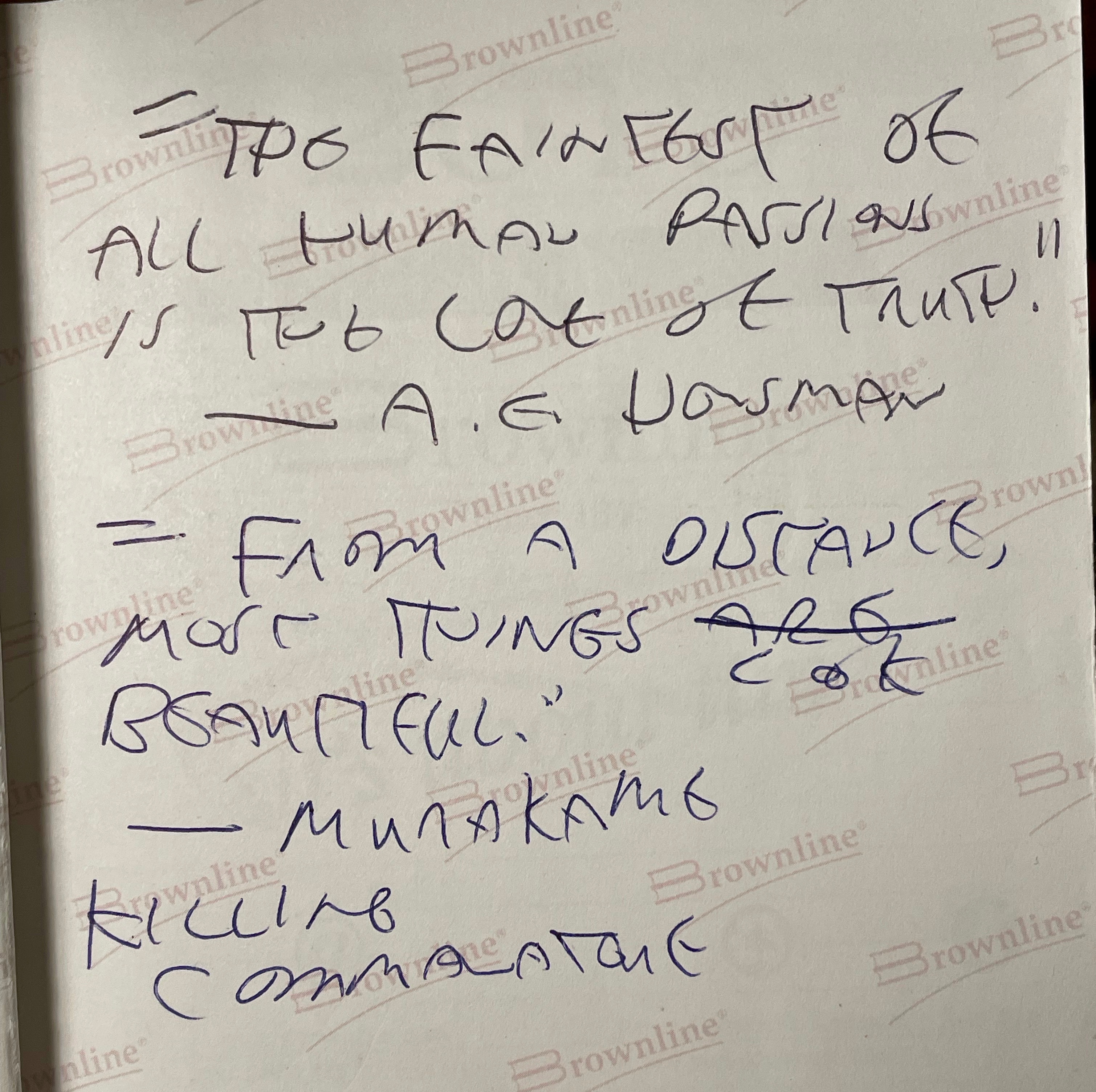
The flyleaf of my 2010 journal, when I was reading the Loeb Seneca and Boswell's "Life of Johnson"

     Ever since this column passed its first decade mark last July 1, I occasionally glance at what was written here 10 years ago. To remind myself, and sometimes post a memorable essay in the "10 years ago on EGD" section at the left side of the page.
    So yesterday, I noticed that, 10 years ago today, I wrote a longish essay on keeping a journal, on the occasion of embarking upon my 30th volume, "You do something for 30 years, you should ask yourself why." Which means tomorrow I open the 40th.
     What's the difference between 30 years of journals and 40? That's easy. There's certainly more spark to an endeavor in your early 50s than early 60s. Whatever I write now won't be as complicated, either because I've already said it once, or finally seen the value of brevity, or I'm simply tired. 
A.E. Housman's "The faintest of all
 human passions is the love of truth,"
alas will probably prove handy in 2024
 My handwriting certainly grows worse.   
     Since I don't want to replicate the piece, I glanced at a few journals, and quickly noticed an aspect completely overlooked at the close of 2013— not only did I write down my own thoughts, such as they were, and happenings of the day, but also record quotes from others I've stumbled upon, admired, thought might be useful, and wanted to hold onto for ready reference. 
     Grist for the mill. In the flyleaf of the journal for 2018 are two passages. One, a line from Brecht: "don't yet rejoice in his defeat, you men/Although the world stood up and stopped the bastard/the bitch that bore him is in heat again."
     Under it, a second quote: "He 'never did or thought of anything but deceiving people," credited to Canto VI p. 192 Dante's Divine Comedy."
     That was referring to
 Pope Alexander — Dante was a passionate hater of popes — but I hardly need to tell you who those quotes struck me as describing. Though I never had reason to use them, probably because I promptly forgot about them. It's so easy to forget stuff. That's why I write it down, hoping I'll stumble upon it again.
    The Brecht quote, by the way, is from a play, "The Resistible Rise of Arturo Ui" that I never saw or read. I must have lifted the quote, second hand, from The New Yorker probably, though looking at the following description of it, from a CSU production, makes me wish we could lure Bob Falls out of retirement — he stepped down from the Goodman in 2023 — to produce it: 
     "Brecht’s shudderingly accurate parallel between Hitler and his henchmen on the one hand, and the old crime lords of Chicago on the other, is a vigorous eye opener that was produced on Broadway with Christopher Plummer. The Cauliflower Trust in Chicago is in need of help and turns to a racketeer by the name of Arturo Ui to begin a 'protection' campaign. His henchmen look astonishingly like Goebbels and Goring. Their activities include 'accidental' fires and a St. Valentine’s Day massacre."
     Some of the quotes did inspire columns — the always-apt remark of Samuel Johnson about society being "held together by communication and information" was the starting off point for a column on Johnson six years later.
     And some turned into 2016's "Out of the Wreck I Rise: A Literary Companion to Recovery," written with Sara Bader, whose entire premise is that these dusty thoughts are useful in running an ordered life. Mental coins to rattle around in your pocket.
     Some years are blank, others full, like 2006, where I wrote, not on the flyleaf, but the page facing the title page: "Journalism is a fleeting thing, and the man who devotes his life to it writes his history in water," crediting H.L. Mencken, the exception who proves the rule. 
     Next to it, in the same vein: "But stay unregenerate. Life knocks the sauciness out of us soon enough," Clifford Odets, in "The Country Girl's Last Links,"no doubt again  found in The New Yorker. Plus a second Odets passage: "I am seething and swollen, lumpy, disordered and baffled, as if I were a woman fifteen months pregnant and unable to sleep or turn, crying aloud, 'Oh God, out, out, out!'"
    Well, that isn't very pleasant — remember in 2006, I was fresh in recovery, and writing "Drunkard," not to mention 30 pounds heavier than I am now, so that sounds about right. The last one, oddly, has no citation, just "Don't heed the distant calls and hold tightly to the golden door. There, beyond it, is hell, longed for." I'm sure Mr. Google can fix that. From "Solitude," by Rilke.
In places, as in the 1991 journey, it was easier
to just cut out than copy.
    Only two on 2003: "Dietrologia (Ital.) the art of finding dark motives behind obvious decisions," which seems a word we could use in 2024, and "Communications have reached their numbing roar," T.H. White, Making of the President 1960, p. 26. If that was true more than 60 years ago, how to describe the blinding wordstorm now? One hesitates to contribute a single additional syllable. But what choice is there, at this point?
     Okay enough. I think that will do, both for sharing not-quite-random quotes and trying to make sense of the year 2023 through words, a task we'll now leave to historians. On deck, 2024, speaking of history. I wish I had the foggiest idea how it'll unfold — my bet is it'll be 2020 on steroids. Or not. Whatever it becomes, dull it won't be, unfortunately. (Doesn't a dull year sound glorious about now?) Whatever is coming, we'll face it here together. Happy New Year. Don't drink and drive. See you tomorrow morning, bright and early.


Saturday, August 31, 2013

Time to stick a fork in Charlie Trotter.


     When Charlie Trotter's restaurant was named "the best restaurant in the world," or something close to that, we were still living in the city, not far away. I told my wife, "I'm not living within walking distance of  'the best restaurant in the world' and never going there." So we went. The place was so pretentious it was disorienting: it felt like the floor was a few degrees off kilter. All the other diners were languid Eurotrash, like the background characters in a James Bond movie. My central memory of the evening was counting 18 $20 bills onto the table and wondering what had possessed me. 
      That informs a bit of this column, which is slated to run in the paper Monday but got posted Friday. I've met Charlie on a few occasions, and to be honest always got along well with him. The me-me-me closing last year set my teeth on edge. I've had a number of high profile chef of my acquaintance who chose another route: Sarah Stegner comes to mind, or Gale Gand, the mastermind of Tru, who steps away from the restaurant to explore other options, teaching classes, working on  a farm, without making a huge deal of it. You can be great without believing yourself the font of all greatness. 
    That isn't to say I'm not without sympathy. I have an ego myself, and it gets inflamed at times, and I feel neglected, and have to re-calibrate myself. I hope this episode leads Trotter to perhaps do the same, though it probably won't. If not, he told another reporter he was going to go the Yukon. I guess we were all supposed to blanch and shout, "No, Charlie, no!"  Me, I thought that might be a good idea, and wished him Godspeed to Alaska. We'll get on fine here without him. We already are. 

     There are two types of chefs. There is what I think of as the "Sarah Stegner Chef," so named after my first glance of Stegner, in a tall white toque, standing dignified in her kitchen at the Ritz-Carlton, arranging the artisanal cheeses she championed, quiet as beauty, still as a river, entirely focused on those gorgeous orbs of fromage, as if they were land mines she was defusing.
     And then there's the "Charlie Trotter Chef"—think of the chefs in Bugs Bunny cartoons, snarling, screaming, flailing, an inflamed, overcooked ego in chef's whites. Those chefs do well on the Food Network. They become stars. The reality, however.
     "He's gone off . . . it's weird," said an associate of Trotter, who knows him well.
     On Thursday, Trotter had some kind of ugly encounter with a group of high school students participating in After School Matters. Trotter allowed them to use his now shuttered namesake restaurant at 814 W. Armitage as a gallery to display their photographs, but became offended, it was reported, when the instructor supervising the students refused to order them to sweep floors and plunge toilets. Trotter also made inappropriate comments to a female student, suggesting she get a Charlie Trotter tattoo.
     So has Trotter gone around the bend?
     "He is . . . a . . . difficult person," said the associate, who didn't want to be named so as to not endanger their relationship. "He comes across like, 'Once you get to know me, I'm a good guy, a funny guy, but everybody hates me, I don't know why.' "
     I do, Charlie, so let me explain it to you.
     People hate egomaniacs. They see the self-regard flowing like wine and naturally want to stop it up. When you closed your restaurant — one year ago; time drags when you're doing nothing, huh? — with maximum drama, it was a curtain-clutching death scene worthy of "Tristan und Isolde," complete massive, three-part hagiography in the Tribune. The observation I bit back— why rain on the man's victory lap? — was: Closing your restaurant was self-immolation, tossing your whole staff out of work in a recession, and why? New chefs were rising, being lauded in the Chicago scene.
     Attention was straying from the only chef worthy of attention — Charlie Trotter. If other restaurants are going to be praised, then you were just going to close yours down, take your ball and go home. You said you were going to read philosophy, which made me laugh. I almost sent you the passages of Seneca where he tells us to welcome loss, because someday life will snatch back every single thing it gave to us, and so the smaller deprivations before then are reminders and practice. But I figured it would be lost on you.
     Charlie took his ball but wouldn't go home. There you were, stomping around the auction of your restaurant's effects, shutting the thing down a third of the way through. A man with any grace wouldn't even have been in the room. If you're going to close, then close.
     And Trotter's still there, rattling around your empty, shuttered restaurant, terrorizing schoolchildren. It's a scene from a tragedy.
     OK, Charlie, you and I are about the same age. And at this point, you're saying: "If you're so smart, why aren't you rich, like I am?" To which I'll retort, "If you're so rich, why aren't you smart?" It's never too late.
     You might want to use this embarrassing public spectacle as a wake-up call; if not, there are more down the road. Trust me on that one. If you can control yourself, do it.
     A little humility might help. I asked your friend: Would you call Charlie a humble man?
     "No, not humble," the friend said. "He knows he's not a humble person. At the end of his run his perception was, 'Where did the respect go? I was the one who brought Chicago fine dining, gave it its reputation.' He kinda started a lot of it, and at the end he felt, 'What the hell, where did the love go?' "
     It goes where everything goes, Charlie. Into the Bonfire of Time. Everything ends.
     It's a shame you never read that philosophy, because it may have helped you now. "A generation of men is like a generation of leaves," Homer writes. We have spring, shine greenly for a summer. It feels like forever. Then autumn comes, Charlie, and we wither, even great chefs like you, and fall off the tree or, in your case, jump — there's a drawback of being rich, you forget that there's a purpose to work beyond making money. Work is joy, if you're lucky. You may have forgotten that.
     But never too late to remember. When Sarah Stegner tired of the Ritz, she quietly re-invented herself and opened the excellent Prairie Grass with husband Rohit Nambiar and partner George Bumbaris. Time to reinvent yourself, too, Charlie, if you can. Grab a spoon, stop talking and start cooking. The respect you seek is waiting for you there.